


African Players Stepped Up In Key Moments, Providing Goals, Balance, And Impact When Aston Villa Needed It Most
The Best of the Best
Aston Villa’s history doesn’t really move in straight lines. It jumps, peaks, drops, rebuilds and resets. And if you trace those moments closely enough, certain Aston Villa players keep showing up at the right time—often without much long-term fanfare.
African players fall into that category more than most. Not a constant presence or a full generation. But when Villa needed something specific—goals, stability, a spark—they showed up, did the job and then moved on.
Christian Benteke

There wasn’t much mystery to Benteke’s game. You knew what was coming. Defenders knew too. It didn’t matter.
He arrived in 2012 and immediately looked like the only reliable way Villa were going to score. Nineteen league goals in his first season. That’s not a hot streak—that’s dependency. The attack ran through him because it had to.
Big frame, strong in the air, and calm when chances fell. Not flashy or particularly intricate. Just inevitable in certain situations.
And here’s the thing people forget: Villa were not a good side then. Benteke’s numbers came in a team that struggled to create consistently. That context matters. Among Aston Villa African players, he’s the closest thing to a centerpiece the club has had.
Ahmed Elmohamady
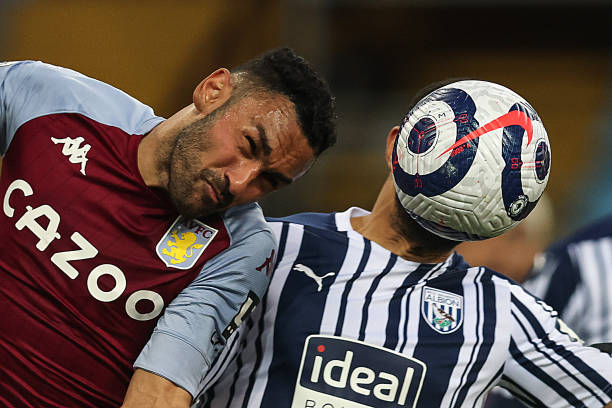
If Christian Benteke was the obvious one, then Ahmed Elmohamady was something else entirely. No noise, no headlines, nothing flashy. Easy to overlook, honestly. But go back to Villa’s 2018-19 climb out of the EFL Championship and it’s there if you bother to look.
Every week, the same story. He didn’t give the kind of performances people rush to praise, but the sort that keeps a team from slipping when it matters.
Right-back. Wide option. Reliable outlet. No drama. Promotion changed everything for Villa financially and structurally. Without it, the rebuild stalls. Elmohamady was part of that spine that kept things from drifting.
You don’t measure that in goals; you measure it in trust. Managers kept picking him for a reason.
Jonathan Kodjia

Kodjia is harder to pin down. There were stretches where he looked like the most dangerous player on the pitch. Quick, direct, and willing to take defenders on without overthinking it. Nineteen goals in his first Championship season backed that up.
But it never quite settled. Injuries interrupted momentum. Form dipped, then returned, then dipped again.
That inconsistency is part of his story. Not failure, just unfinished. Still, during a messy period for the club, he gave Villa something unpredictable in attack. That counts.
Bertrand Traoré

Traoré doesn’t flood games; he picks them. Signed in 2020, he brought something Villa didn’t really have at the time—an attacker willing to create from awkward angles. Cut inside, shoot early, try something slightly off-script.
Seven league goals in his first season isn’t massive, but a few of them were important; tight games with small margins.
He’s the type of player you notice in flashes. Then you go back later and realize those flashes shifted results. Not consistent enough to dominate a season, yet dangerous enough to matter anyway.
Moustapha Salifou

Salifou’s name doesn’t come with highlight reels. He joined in 2007 after the World Cup with Togo, which tells you more about the moment than the outcome. Villa was looking outward, exploring different markets, adjusting how they recruited.
He barely featured. That’s the reality. But players like Salifou still sit in the timeline. They mark a shift—however small—in how a club operates. Not every contribution shows up on a stat sheet.
So What Ties These Players Together?
Villa haven’t had a long-running African core the way some clubs have. Instead, these players appear at pressure points:
- Benteke, when goals were scarce
- Elmohamady, when structure mattered
- Kodjia, during a rebuild that kept stalling
- Traoré adds creativity to a modern squad
Different roles. Different eras. Same pattern—specific problems, specific solutions.
And if you zoom out, that tells you something about how the Aston Villa squad has evolved.
Recruitment hasn’t always been about building identities. Sometimes it’s been about plugging gaps fast enough to stay competitive.
For a broader look at how these names compare across eras, the full list of Aston Villa greatest players gives that wider context.
African Legacy in Villa Park
None of these players define Aston Villa on their own. That’s probably why they get overlooked. But remove Benteke’s goals, or Elmohamady’s stability during promotion, and the club’s recent history looks different. Maybe worse. That’s the uncomfortable part.
- Who is the greatest African player of all time?
- Is Ollie Watkins mixed race?
- Who was the first black player for Aston Villa?
African players at Villa rarely take the headline slot. They end up being the fix instead. The ones who come in, sort out a problem, and move on before anyone bothers to build a story around it.
Look a bit closer, though, and those are usually the players that actually shift things. Not always the flashy names. Not always the ones that win the press cycle. But the ones that leave a mark where it counts.