

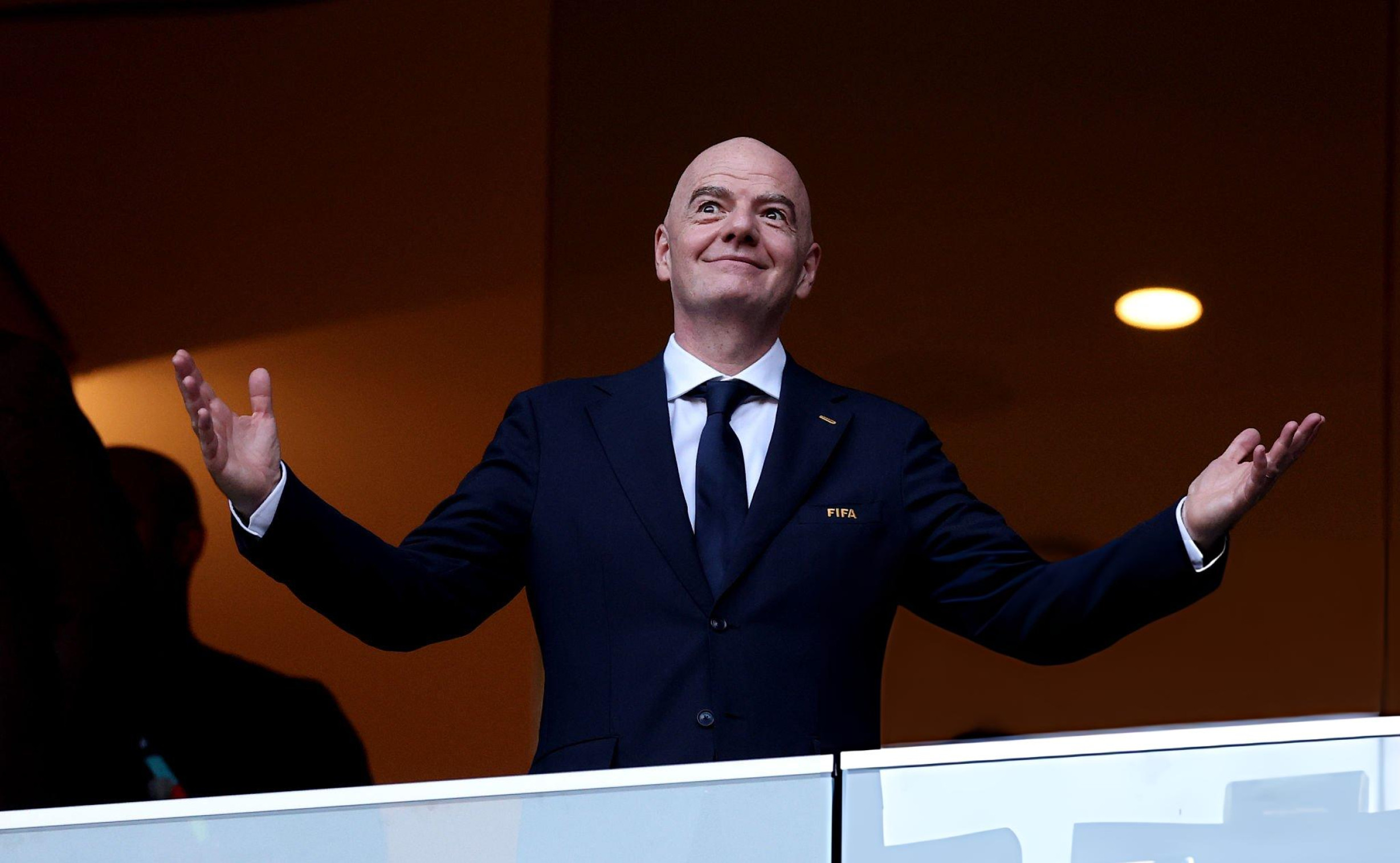
Three powerful confederations unite against FIFA and Infantino leadership as abandoned World Cup commercial plan triggers unprecedented confrontation.
The battle for control of world football has taken a dramatic turn.
FIFA President Gianni Infantino is facing one of the strongest challenges to his leadership since taking office after UEFA, the Asian Football Confederation (AFC) and Concacaf jointly accused FIFA of breaking the trust of the football family through what they described as “deception”, a lack of consultation and a profound failure of judgement.
In a strongly worded open letter published on Monday, August 10, 2026, the presidents and general secretaries of the three confederations stopped short of naming Infantino directly and the message was unmistakable.
The six senior officials warned that football leadership is supposed to be a “duty of service”, not a means of accumulating or demanding power.
They declared that trust had been broken when an individual placed himself above the collective institutions that entrusted him with authority.
The extraordinary letter comes after the collapse of FIFA’s controversial FIFA Forward Enterprise (FFE) proposal, which would have created a new company to manage the commercial and ticketing rights of FIFA competitions, including the World Cup.
The proposal included plans for a 21% stake in the company to be sold to a private investment company.
What began as a commercial proposal has now developed into a much larger battle over FIFA’s governance, transparency and the future direction of world football.
And according to reports, the disagreement could go even further.
Preliminary discussions have taken place between UEFA, Concacaf and the AFC about the possibility of creating breakaway competitions if Infantino remains FIFA president.
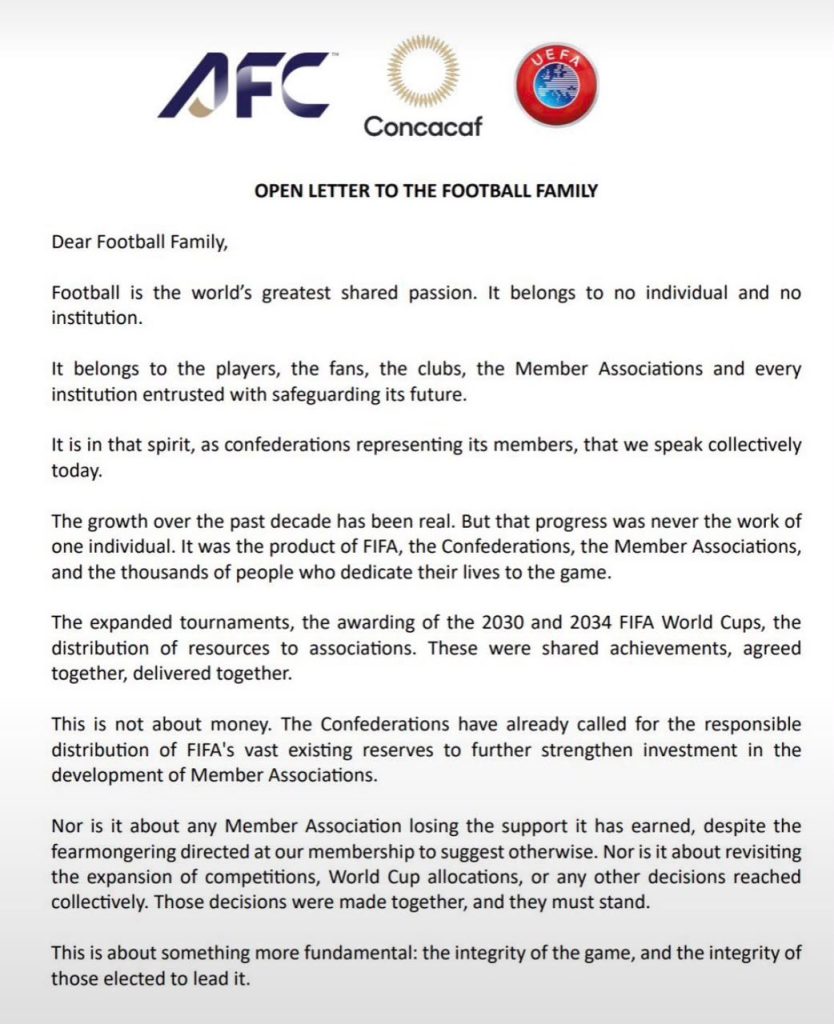
‘This is About the Integrity of the Game’
The three confederations were careful to insist that their opposition was not fundamentally about money.
Instead, they framed the dispute as a battle over how the global game should be governed.
Their letter began stating that football does not belong to one person or institution.
“Football is the world’s greatest shared passion. It belongs to no individual and no institution.”
The statement continued:
“It belongs to the players, the fans, the clubs, the Member Associations and every institution entrusted with safeguarding its future.”
The confederations acknowledged the significant growth of football over the past decade but rejected the idea that such progress could be attributed to one individual.
“The growth over the past decade has been real but that progress was never the work of one individual.”
“It was the product of FIFA, the Confederations, the Member Associations, and the thousands of people who dedicate their lives to the game.”
They specifically pointed to the expansion of competitions, the awarding of the 2030 and 2034 World Cups and the distribution of resources to member associations as achievements that had been collectively agreed and delivered.
“The expanded tournaments, the awarding of the 2030 and 2034 FIFA World Cups, the distribution of resources to associations.”
“These were shared achievements, agreed together, delivered together.”
Then came the central message.
“This is not about money.”
The confederations said they had already called for FIFA’s existing financial reserves to be responsibly distributed to strengthen investment in football development.
They also insisted they were not seeking to reverse previous collective decisions regarding competition expansion, World Cup allocations or financial support.
“This is about something more fundamental: the integrity of the game, and the integrity of those elected to lead it.”
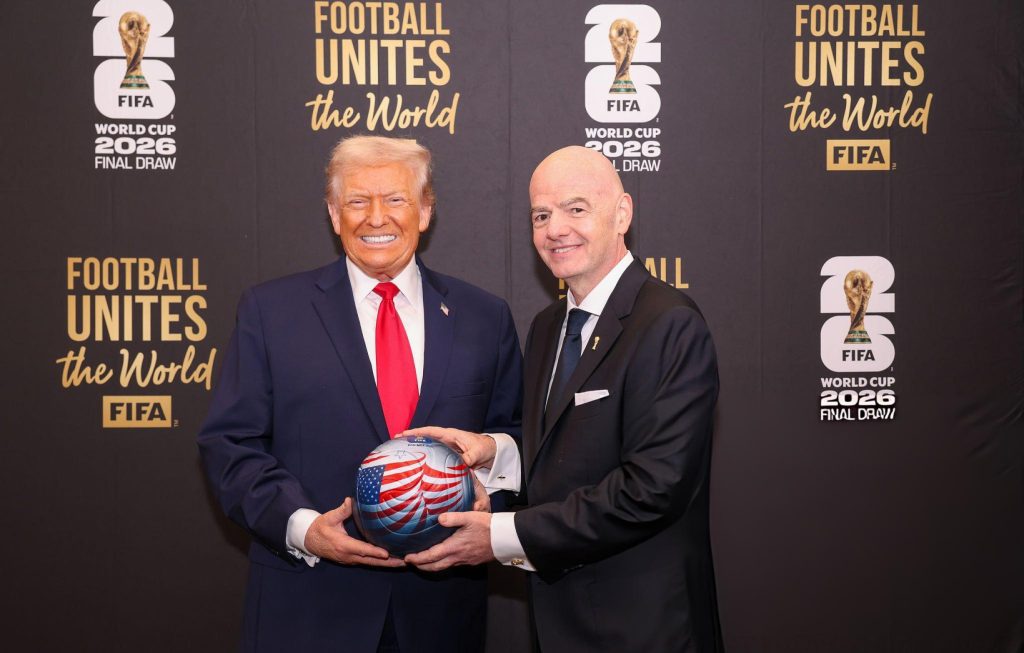
‘When Trust is Broken Through Deception’
The strongest words in the letter were reserved for the issue of trust.
Without naming Infantino, UEFA President Aleksander Čeferin, AFC President Salman bin Ibrahim Al Khalifa and Concacaf President Victor Montagliani, alongside their general secretaries, issued a direct warning about leadership.
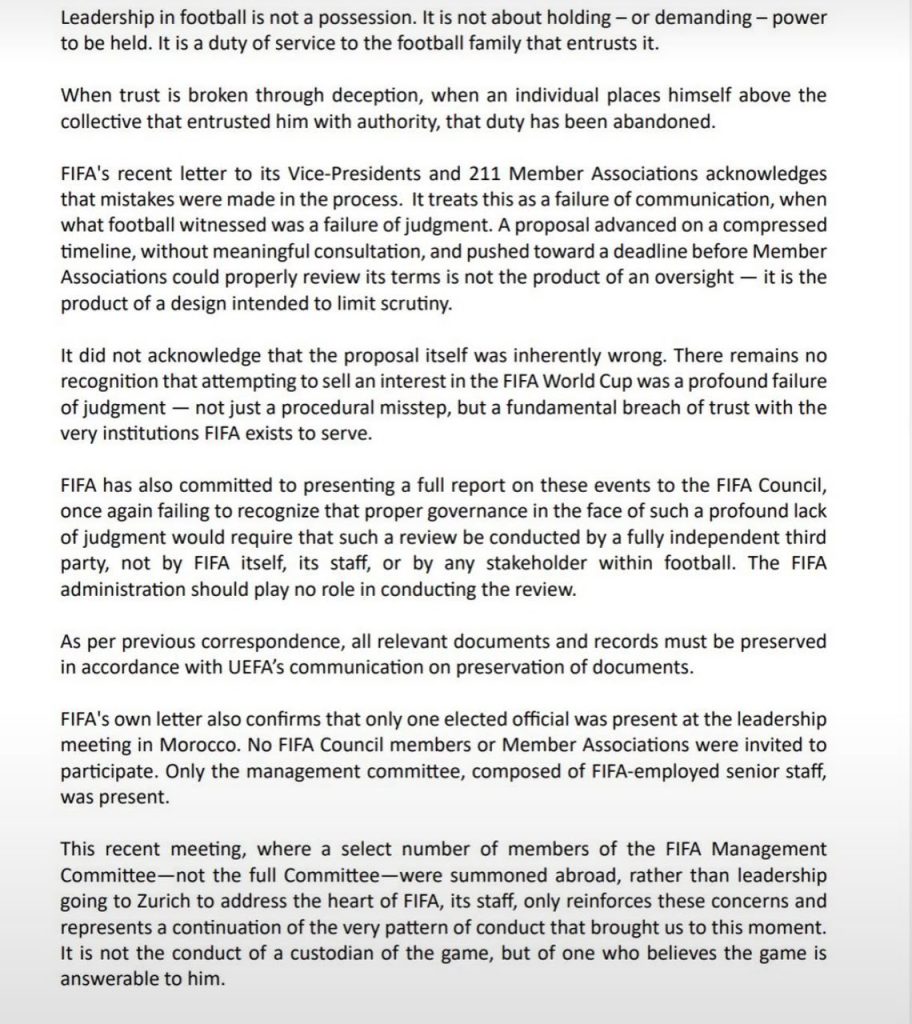
“Leadership in football is not a possession. It is not about holding or demanding power to be held.”
“It is a duty of service to the football family that entrusts it.”
They then delivered the statement that has placed FIFA’s leadership under unprecedented pressure:
“When trust is broken through deception, when an individual places himself above the collective that entrusted him with authority, that duty has been abandoned.”
The statement did not explicitly call for Infantino’s resignation.
However, according to reports, the letter should be interpreted as an opportunity for the FIFA president to step aside and leave his position with dignity.
That interpretation adds another layer of seriousness to an already extraordinary confrontation.
FIFA’s Defence has Failed to Satisfy the Confederations
FIFA has acknowledged that mistakes were made during the FFE process, but UEFA, AFC and Concacaf believe that explanation does not go nearly far enough.
FIFA’s previous communication to its vice-presidents and 211 member associations characterised the controversy as a failure of communication.
The three confederations strongly rejected that assessment.
“FIFA’s recent letter to its Vice-Presidents and 211 Member Associations acknowledges that mistakes were made in the process.”
“It treats this as a failure of communication, when what football witnessed was a failure of judgement.”
They argued that the proposal was advanced too quickly, without meaningful consultation, while being pushed towards a deadline that limited the ability of member associations to properly examine the terms.
The letter went even further:
“A proposal advanced on a compressed timeline, without meaningful consultation, and pushed towards a deadline before Member Associations could properly review its terms is not the product of an oversight.
“It is the product of a design intended to limit scrutiny.”
That is one of the most serious accusations contained in the letter.
The confederations are effectively arguing that the process was not simply badly managed, it was designed in a way that restricted scrutiny.
‘The Proposal Itself was Inherently Wrong’
The confederations also took issue with FIFA’s failure to acknowledge that the FFE proposal itself was fundamentally flawed.
“It did not acknowledge that the proposal itself was inherently wrong.”
They specifically objected to the idea of selling an interest in the FIFA World Cup.
“There remains no recognition that attempting to sell an interest in the FIFA World Cup was a profound failure of judgement, not just a procedural misstep, but a fundamental breach of trust with the very institutions FIFA exists to serve.”
The escalated issue, according to the three confederations, is not merely whether FIFA followed the correct procedure.
It is whether FIFA’s leadership crossed a fundamental line by attempting to commercialize an interest in the World Cup without the meaningful involvement of the organizations that make up the global football structure.
They Want an Independent Investigation
FIFA has committed to presenting a full report on the FFE controversy to the FIFA Council but UEFA, AFC and Concacaf do not believe FIFA should investigate itself.
They want an independent third party to examine what happened.
“FIFA has also committed to presenting a full report on these events to the FIFA Council, once again failing to recognise that proper governance in the face of such a profound lack of judgement would require that such a review be conducted by a fully independent third party, not by FIFA itself, its staff, or by any stakeholder within football.”
They added:
“The FIFA administration should play no role in conducting the review.”
The confederations also repeated a legal warning regarding the preservation of documents.
“As per previous correspondence, all relevant documents and records must be preserved in accordance with UEFA’s communication on preservation of documents.”
That demand could become important if the dispute develops into a formal investigation or legal confrontation.
The Morocco Meeting Becomes Another Flashpoint
The confederations also criticised the way FIFA handled a meeting in Rabat, Morocco, last Wednesday.
According to the letter, FIFA’s own communication confirmed that only one elected official attended the leadership meeting.
FIFA Council members and member associations were not invited.
Instead, the meeting involved FIFA’s senior management staff.
“FIFA’s own letter also confirms that only one elected official was present at the leadership meeting in Morocco.”
“No FIFA Council members or Member Associations were invited to participate.”
“Only the management committee, composed of FIFA-employed senior staff, was present.”
The confederations said the decision to summon selected members of FIFA’s management committee abroad rather than having FIFA leadership return to Zurich to address its staff only deepened their concerns.
“This recent meeting, where a select number of members of the FIFA management committee, (not the full committee) were summoned abroad, rather than leadership going to Zurich to address the heart of FIFA, its staff, only reinforces these concerns and represents a continuation of the very pattern of conduct that brought us to this moment.”
Then came another devastating line:
“It is not the conduct of a custodian of the game, but of one who believes the game is answerable to him.”
‘There is Silence Where There Should be Accountability’
The joint statement ended with a powerful accusation against FIFA’s current leadership culture.
The confederations said football deserved better and explained why they had chosen to issue the statement collectively.
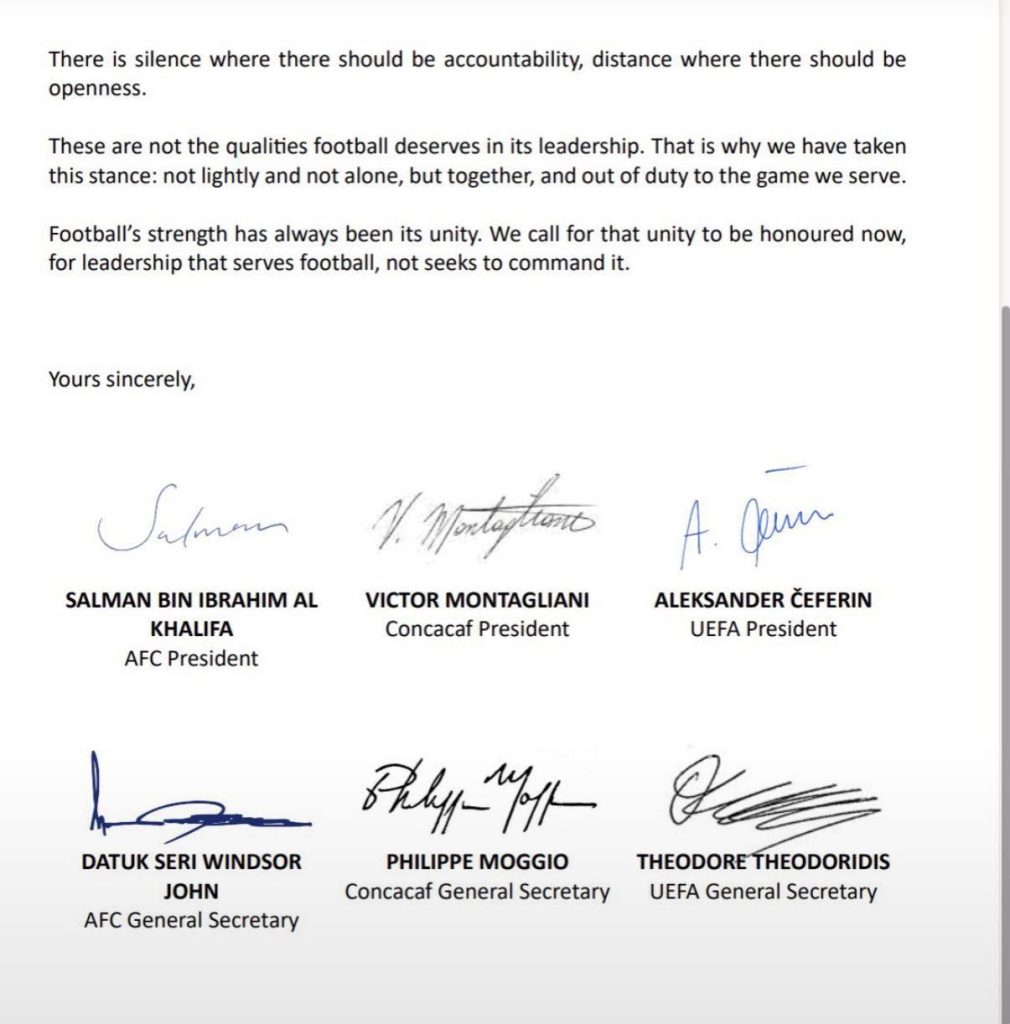
“There is silence where there should be accountability, distance where there should be openness.”
“These are not the qualities football deserves in its leadership.”
“That is why we have taken this stance: not lightly and not alone, but together, and out of duty to the game we serve.”
And they finished with an appeal for unity, but a very different type of unity from the one FIFA has been promoting.
“Football’s strength has always been its unity.”
“We call for that unity to be honoured now, for leadership that serves football, not seeks to command it.”
Could World Football be Heading Towards a Split?
The biggest question now is what happens next.
UEFA has already threatened a boycott of FIFA competitions over the controversy.
Reports also indicate that UEFA, Concacaf and the AFC have held preliminary discussions about possible breakaway competitions if Infantino remains in office.
No concrete format, timetable or competition structure has been announced.
And importantly, the three confederations are not yet united across all of their members.
Concacaf has not publicly committed to a boycott, while Mexico has publicly expressed support for Infantino.
Within the AFC, opposition to the FIFA president is also far from universal.
Of the AFC’s 46 members, eight countries have publicly backed Infantino:
- the United Arab Emirates,
- Qatar,
- Sri Lanka,
- Lebanon,
- Kuwait,
- Mongolia,
- the Philippines and
- Bhutan.
That means the confrontation at confederation level does not automatically translate into a complete revolt among FIFA’s 211 member associations.
However, the fact that three major confederations have jointly issued such a strongly worded statement represents a significant development.
The First Test Could Arrive Within Weeks
The first practical test of UEFA’s boycott threat could come sooner than expected.
The FIFA Under-20 Women’s World Cup is scheduled to begin in Poland in just over three weeks.
The tournament includes five other European nations, including England.
France has already indicated that it still plans to participate.
That means the coming weeks could reveal whether the current dispute develops into an actual sporting confrontation or remains primarily a governance battle.
If UEFA members begin withdrawing from FIFA competitions, the consequences could be enormous.
If they do not, FIFA may survive the current crisis without the dramatic split that some have begun to contemplate.
A Fight Bigger than the FFE Proposal
The abandoned FIFA Forward Enterprise proposal may have been the spark of controversy but the open letter makes clear that UEFA, AFC and Concacaf believe the real issue is much larger.
They are questioning how decisions are made at FIFA.
They are questioning how much power should rest with its president.
They are demanding independent scrutiny.
They are demanding accountability.
And, most significantly, they are challenging what they perceive as a shift from collective governance towards centralised authority.
The letter was signed by
- AFC President Salman bin Ibrahim Al Khalifa,
- Concacaf President Victor Montagliani and
- UEFA President Aleksander Čeferin, alongside
- AFC General Secretary Datuk Seri Windsor John,
- Concacaf General Secretary Philippe Moggio and
- UEFA General Secretary Theodore Theodoridis.
Together, they have placed one unmistakable message before the football world.
The World Cup may have only recently crowned its champions, but another battle is already taking shape behind the scenes.
This is a battle over who ultimately holds the power to shape the future of the world’s game.
And with three of the world’s most powerful football confederations now openly questioning FIFA’s leadership, the biggest question may no longer be what happens to the abandoned FFE proposal.
It may be what happens to Gianni Infantino’s presidency.