

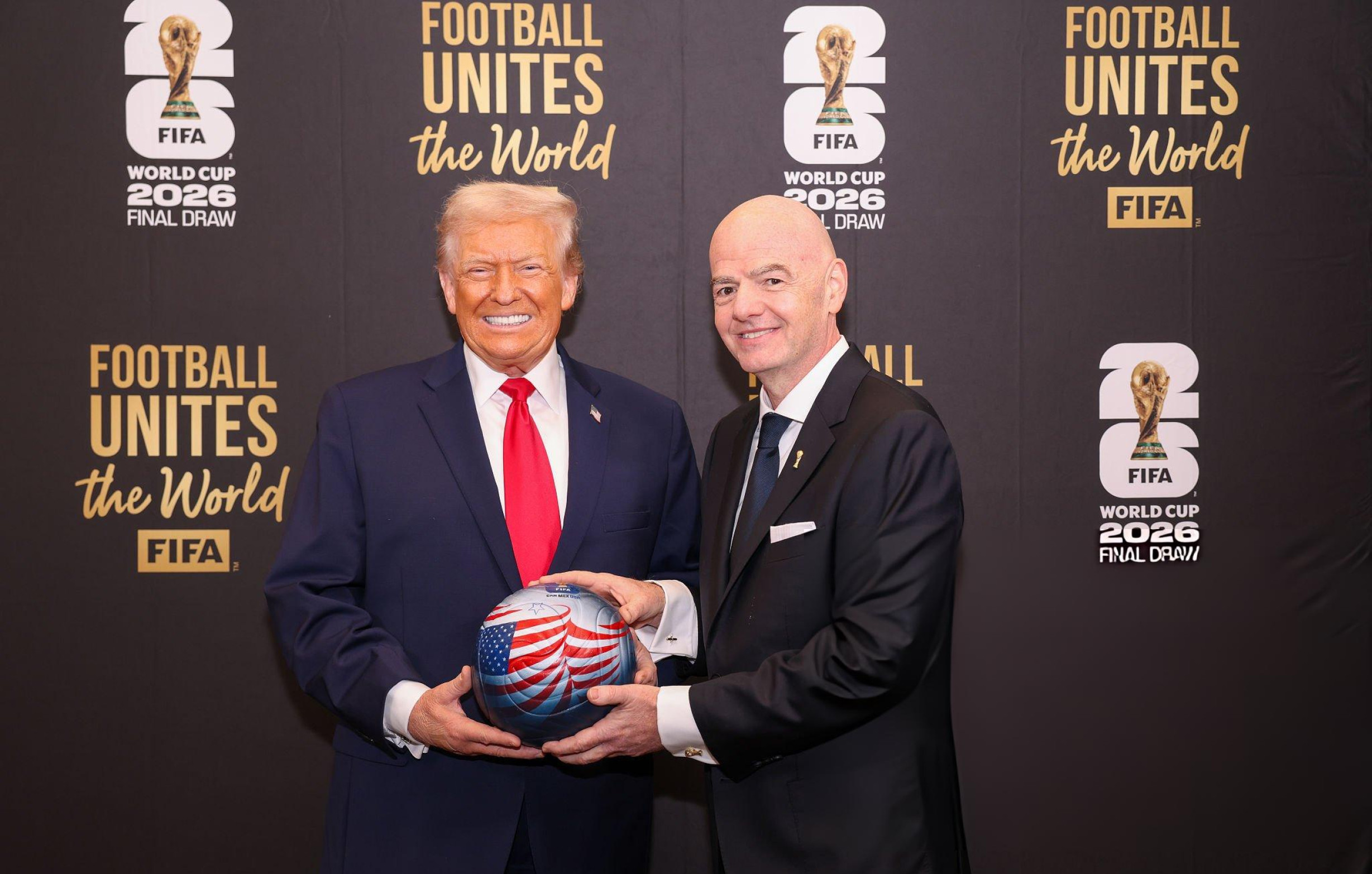
US President Donald Trump has publicly thrown his weight behind embattled FIFA president Gianni Infantino, warning that world football’s governing body would be making a “terrible mistake” if it removed the Swiss administrator from his position.
Trump’s intervention comes at a time when Infantino is facing the most serious political challenge of his FIFA presidency, with UEFA, Concacaf and the Asian Football Confederation (AFC) accusing the FIFA leadership of breaking trust “through deception” over the now-abandoned FIFA Forward Enterprise (FFE) proposal.
The dispute has moved far beyond the original commercial proposal.
What began as a controversial plan to create a new company to manage FIFA’s commercial and ticketing rights has now developed into a major governance battle involving some of football’s most powerful confederations and the possibility of boycotts and even breakaway competitions.
And now, Trump has entered the fight.
Removing Infantino Would be a ‘Terrible Mistake’ – Trump
In a post on his Truth Social platform, Trump delivered an unequivocal defence of Infantino and praised the FIFA president for his handling of the 2026 World Cup.
The US president wrote:
“FIFA would be making a terrible mistake if, for any reason, they even considered replacing president Gianni Infantino.”
Trump continued:
“He is fantastic, having just presided over the most successful World Cup, by four times, ever presented.”
“If he is gone, it will never be as successful or profitable again!”
He ended the message:
“Thank you for your attention to this matter. President DJT.”
The intervention represents Trump’s strongest public defence of Infantino since details of the FFE proposal became public on 28 July.
It also comes as pressure continues to build around Infantino’s leadership, with three major confederations openly questioning his approach to FIFA governance.
Trump and Infantino Have a Close Relationship
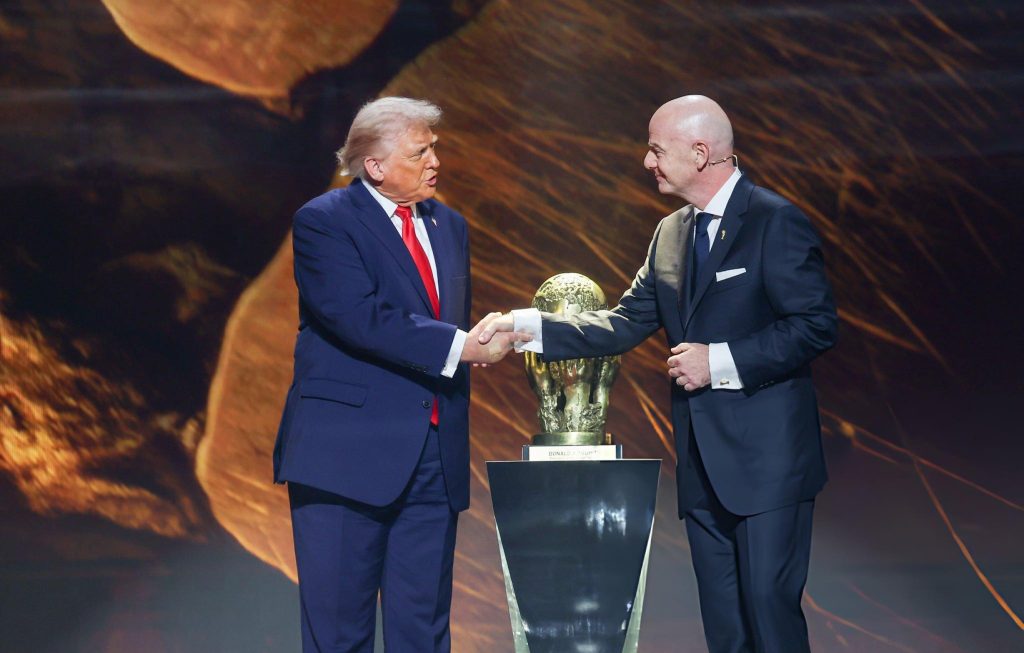
Trump’s intervention is particularly significant because of his existing relationship with Infantino.
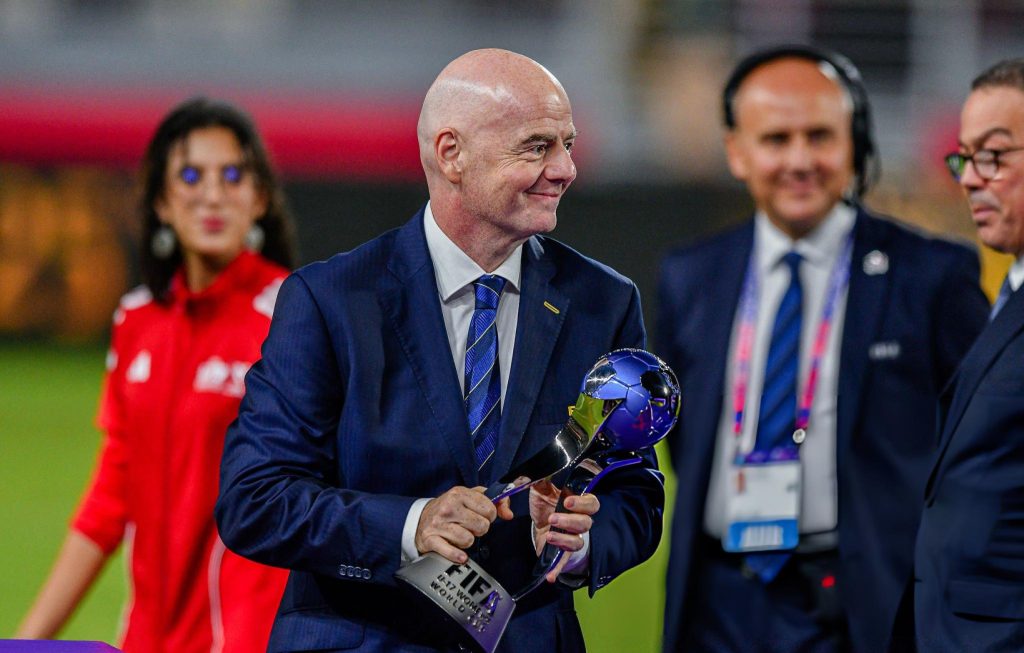
The FIFA president has maintained close ties with the US president, and in December 2025 Infantino awarded Trump the inaugural FIFA Peace Prize.
The 2026 World Cup was also jointly hosted by the United States, Canada and Mexico.
Trump’s latest comments therefore place him firmly on Infantino’s side as the FIFA president battles mounting criticism from within the football establishment.
When Trump first addressed the FFE proposal on 31 July, he said he had not spoken to Infantino about the plans.
His latest intervention, however, leaves little doubt about his position.
What Started the Crisis?
At the heart of the dispute is the FIFA Forward Enterprise proposal (FFE).
FFE would have involved the creation of a new company to oversee the commercial and operational aspects of FIFA competitions, including the World Cup.
A significant portion of the company, around 20 to 21 per cent, was proposed to be sold to private investors.
Thrive Eternal was expected to lead the proposed investment group.
The American venture capital firm was founded by Joshua Kushner, the brother of Trump’s son-in-law Jared Kushner.
The proposal was eventually abandoned following strong opposition from several FIFA confederations.
Infantino later apologised and acknowledged mistakes had been made during the process, but for UEFA, Concacaf and the AFC, the apology did not settle the matter.
Instead, the three confederations escalated their criticism.
‘A Fundamental Breach of Trust’ – Infantino Accused
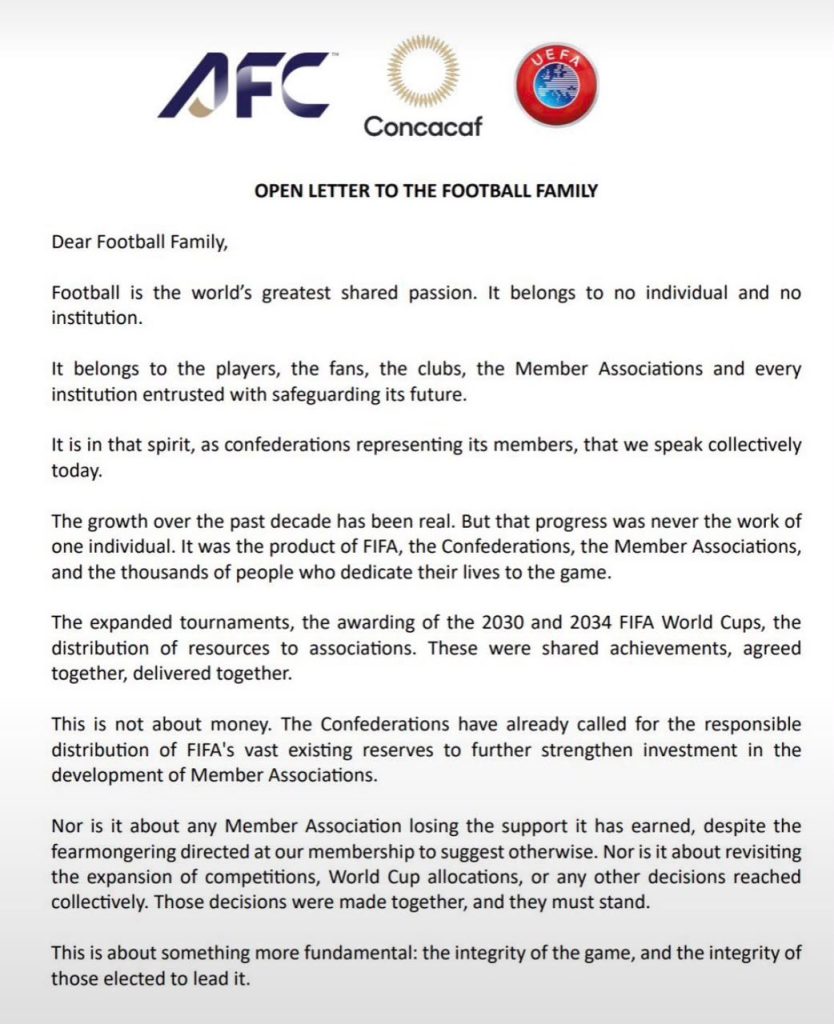
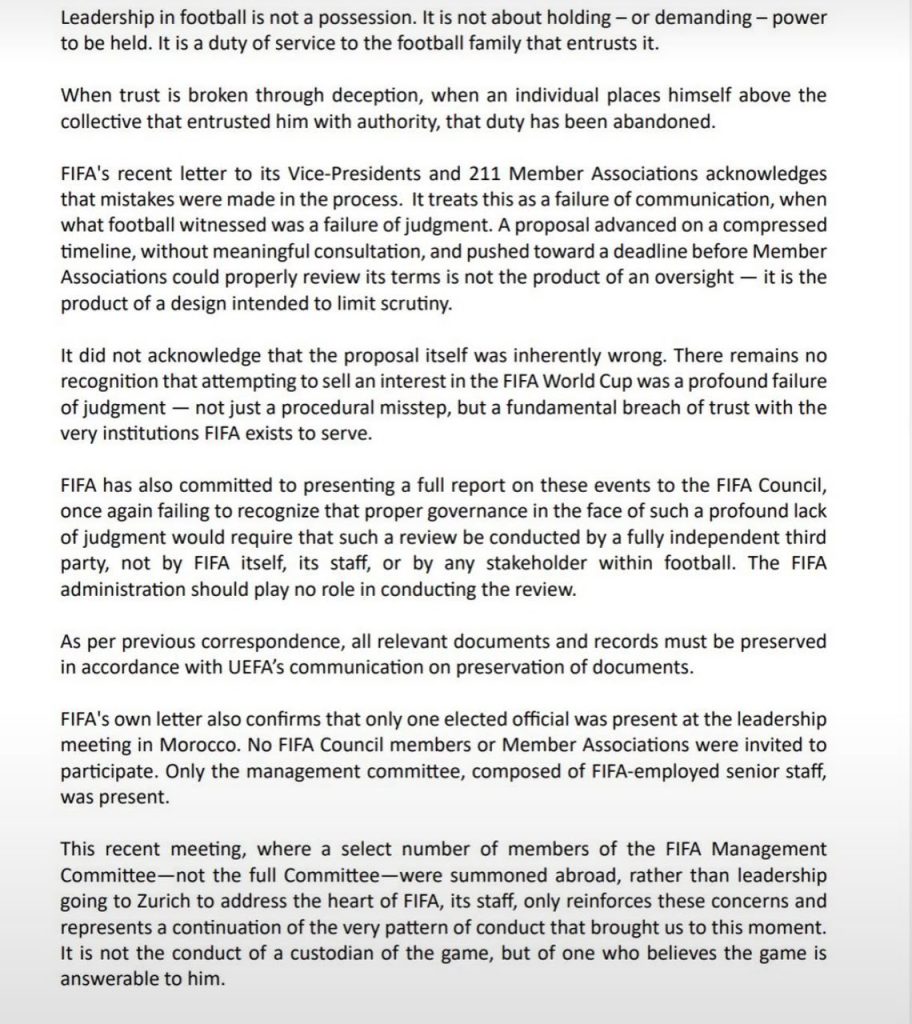
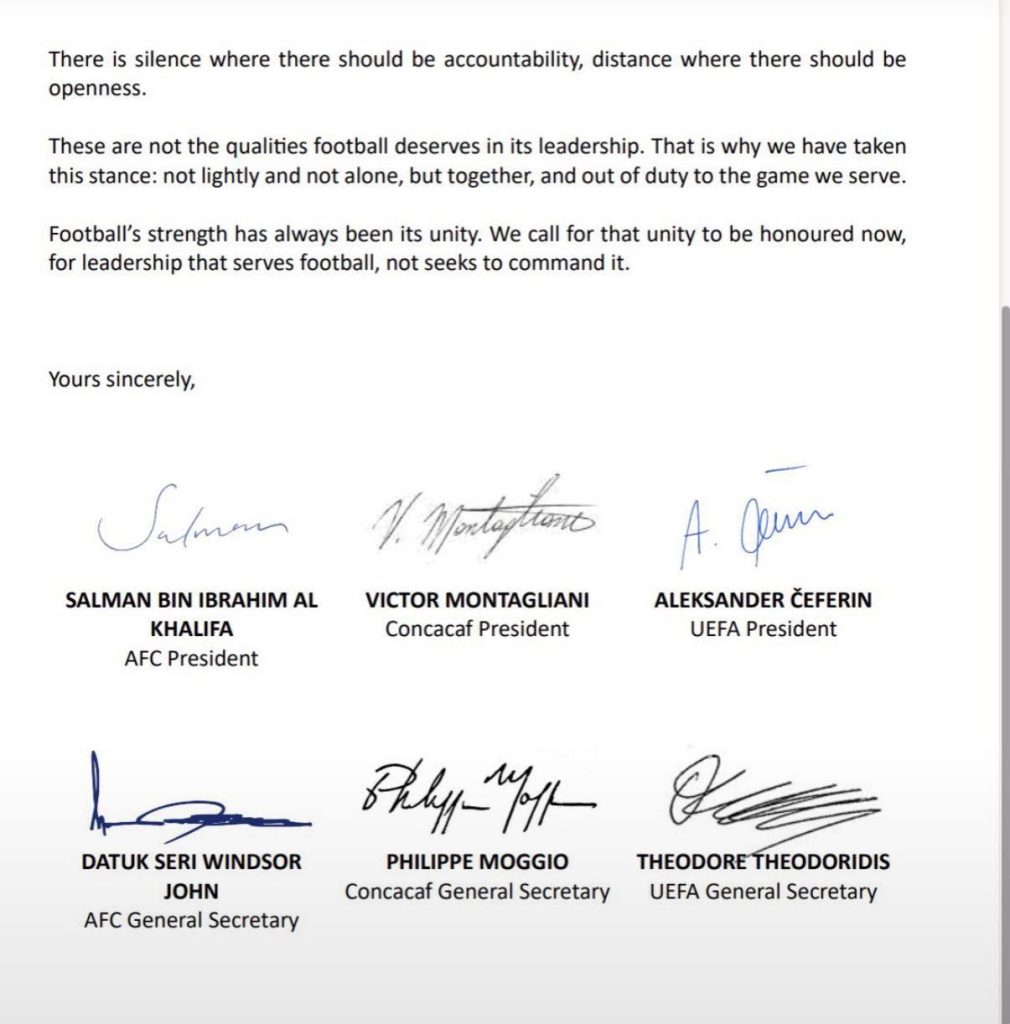
In an extraordinary joint open letter to the football community,
- UEFA president Aleksander Čeferin,
- Concacaf president Victor Montagliani and
- AFC president Salman bin Ibrahim Al Khalifa,
alongside their respective general secretaries, accused FIFA’s leadership of failing to understand the seriousness of what had happened.
The letter stated:
“This is about something more fundamental: the integrity of the game, and the integrity of those elected to lead it.”
The confederations argued that football’s governing structures were based on collective responsibility rather than the authority of one individual.
They wrote:
“Leadership in football is not a possession. It is not about holding or demanding power to be held.”
“It is a duty of service to the football family that entrusts it.”
The strongest warning came soon after:
“When trust is broken through deception, when an individual places himself above the collective that entrusted him with authority, that duty has been abandoned.”
Although Infantino was not named directly in the letter, the message was widely interpreted as a direct challenge to his leadership.
Sources have indicated that the statement could be viewed as an opportunity for Infantino to resign and leave office with dignity.
UEFA, Concacaf and AFC Reject FIFA’s Explanation
FIFA had described the problems surrounding FFE as mistakes in communication.
The three confederations strongly rejected that characterisation.
They argued that the issue was much deeper than a communication failure.
The letter stated:
“FIFA’s recent letter to its Vice-Presidents and 211 Member Associations acknowledges that mistakes were made in the process.”
“It treats this as a failure of communication, when what football witnessed was a failure of judgement.”
The confederations accused FIFA of advancing the proposal on a compressed timeline without sufficient consultation.
They added:
“A proposal advanced on a compressed timeline, without meaningful consultation, and pushed towards a deadline before Member Associations could properly review its terms is not the product of an oversight – it is the product of a design intended to limit scrutiny.”
And they went even further:
“It did not acknowledge that the proposal itself was inherently wrong.”
The letter continued:
“There remains no recognition that attempting to sell an interest in the FIFA World Cup was a profound failure of judgement not just a procedural misstep, but a fundamental breach of trust with the very institutions FIFA exists to serve.”
Calls for an Independent Investigation
FIFA has committed to producing a report on the FFE episode for the FIFA Council.
However, UEFA, Concacaf and the AFC believe FIFA should not be responsible for investigating itself.
They called for a fully independent third-party review.
The letter stated:
“FIFA has also committed to presenting a full report on these events to the FIFA Council, once again failing to recognise that proper governance in the face of such a profound lack of judgement would require that such a review be conducted by a fully independent third party, not by FIFA itself, its staff, or by any stakeholder within football.”
The confederations also demanded that all relevant documents connected to the abandoned proposal be preserved.
Their concern extends beyond FFE itself.
The Morocco Meeting Adds Fuel to the Fire
Another source of tension was a FIFA management meeting held in Morocco.
According to the joint letter, only one elected FIFA official was present.
FIFA Council members and member associations were not invited.
Instead, the meeting involved FIFA-employed senior staff.
The confederations were particularly critical of the decision to summon selected members of FIFA’s management committee abroad rather than addressing the organisation’s leadership at its headquarters in Zurich.
They wrote:
“This recent meeting, where a select number of members of the FIFA management committee – not the full committee – were summoned abroad, rather than leadership going to Zurich to address the heart of FIFA, its staff, only reinforces these concerns and represents a continuation of the very pattern of conduct that brought us to this moment.”
The letter concluded with perhaps its most pointed criticism:
“It is not the conduct of a custodian of the game, but of one who believes the game is answerable to him.”
And then:
“There is silence where there should be accountability, distance where there should be openness.”
FIFA hits back at Infantino’s critics
The escalating dispute has also prompted a strong response from FIFA.
The organisation accused critics of attempting to weaken Infantino’s authority and remove him without going through the established electoral process.
FIFA said:
“It is increasingly evident that there is a concerted and ongoing effort by some to undermine FIFA and its president.”
The governing body added:
“Those who do not have the support of FIFA’s member associations should not seek to achieve through allegation, insinuation or misinformation what they cannot achieve through FIFA’s established democratic processes.”
FIFA also rejected what it described as inaccurate reporting and unsubstantiated allegations.
The statement continued:
“Recent reporting has included unsubstantiated assertions and demonstrably false claims concerning FIFA and its president.”
“Speculation and insinuation should not be presented as fact, and repetition does not make an allegation true.”
The governing body defended Infantino’s record and his contribution to football.
“The FIFA president has dedicated more than 30 years of his professional life to European and world football, contributing to significant change in the game and, in particular, to broadening access, resources and opportunity across world football.”
FIFA insisted it would not be distracted from its work.
“FIFA welcomes legitimate scrutiny, but scrutiny is not a licence to distort facts, amplify unsubstantiated allegations or manufacture distractions designed to undermine progress.”
It concluded:
“FIFA’s responsibility is to its 211 member associations and to football around the world.”
“We will not be distracted or diverted from strengthening the organisation, delivering for our member associations and continuing the work of making football truly global.”
Could Football be Heading Towards a Split?
The dispute has now raised a question that would have seemed almost unthinkable only weeks ago:
Could some of the world’s biggest football confederations eventually break away from FIFA competitions?
UEFA has already threatened a boycott of FIFA competitions while Infantino remains in office.
There have also been preliminary discussions involving UEFA, Concacaf and the AFC about possible breakaway competitions should Infantino remain FIFA president.
However, substantive discussions have reportedly not yet begun, and neither Concacaf nor the AFC has publicly committed to a boycott.
There is also opposition to Infantino that is far from universal within those confederations.
Mexico, for example, has publicly backed the FIFA president.
Among the AFC’s 46 member associations, eight countries have so far publicly supported Infantino: the United Arab Emirates,
- Qatar,
- Sri Lanka,
- Lebanon,
- Kuwait,
- Mongolia,
- the Philippines and
- Bhutan.
That makes the battle over Infantino’s future far from straightforward.
Another controversy Adds to the Pressure
The FFE dispute is not the only issue surrounding Infantino at present.
UEFA recently confirmed that a “departure payment” had been made to a female employee who was alleged to have been in a relationship with Infantino during his time as UEFA general secretary.
UEFA confirmed that a payment had been made and that fees for an MBA course had also been covered, saying the arrangement was in line with regulations at the time.
The development has added another layer to the controversy surrounding the FIFA president.
Infantino worked at UEFA for 16 years and served as its general secretary from 2009 until 2016, before being elected FIFA president following the corruption crisis that engulfed world football.
He has been FIFA president since 2016.
His current term runs until 2027, and he has already announced his intention to seek re-election, potentially extending his tenure until 2031.
The First Test is Already Approaching
The political crisis could soon spill onto the football pitch.
UEFA’s boycott threat will face an early test with the FIFA Under-20 Women’s World Cup, which is scheduled to begin in Poland in just over three weeks.
The tournament features several European teams, including England.
France have already indicated that they still intend to participate.
That leaves FIFA facing an extraordinary situation: a governing body preparing for its next major competitions while some of its most influential confederations openly question its leadership.
And now, will football’s most powerful institutions can repair a relationship that UEFA, Concacaf and the AFC say has already been broken?
And whether Infantino can survive the fight for control of the organisation he has led for more than a decade.