

Former Super Falcons head coach, Randy Waldrum has revealed his most comprehensive and candid account yet of his time in charge of Nigeria’s women’s national team.
He revealing a mix of passion, frustration, and deep administrative challenges that shaped his four-year tenure.
In a wide-ranging interview with EaglesTracker, the 67-year-old American discussed;
- his excitement upon taking the job,
- his failed first appointment in 2017,
- the controversy surrounding his dual roles with the University of Pittsburgh, and
- the financial struggles that forced him into keeping two jobs.
The former Nigeria coach details unpaid salaries, NFF communication lapses, and his dual-job controversy in explosive interview
“I Was So Excited” – Waldrum on Why He Took the Job
Randy Waldrum said coaching Nigeria was one of the most exciting prospects of his career, stating that he saw enormous potential for the women’s game.
“When the opportunity to coach Nigeria came, I was so excited to take on the project. The country has so much potential for doing great things, men and women.”
My hope was when I took the job, I thought I could bring some new ideas and new thought processes.”
“Especially with the USA women being the best in the world, my country, I thought I could bring some ideas, the long-term planning.”
“I had developed a ten-year plan for Nigeria for youth football and how we would translate it into winning the World Cup in the next ten years.”
“I know you have great players, you have always had the players. I felt what was lacking is the organization.”
“I loved my four years I spent with the Super Falcons, we had a lot of great success, so I loved my time.”
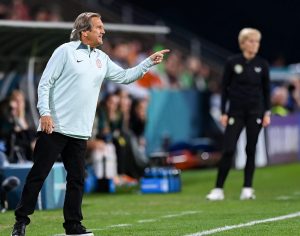
Why He Initially Rejected Nigeria in 2017 – Waldrum
Waldrum also sought to clear the air on the long-standing confusion over why he turned down the Super Falcons job in 2017.
He described chaotic communication and a lack of clarity from the Nigeria Football Federation (NFF).
“I was between jobs at the time. I had left the Houston Dash… and I was trying to decide what my next move would be.”
“At the time, Pinnick was NFF President and he had reached out through our USA Soccer President to see if I was interested. I told Sunil Gulati I would be.”
“This was around September that year, and I didn’t hear anything from US Soccer about taking the job.”
“A month later, my phone is blowing up with people congratulating me, and I saw on social media that I was the new coach of the Super Falcons but I had never spoken to President Pinnick or anyone from the federation.”
Waldrum said his attempts to get clarification proved futile:
“From September I was trying to reach out to someone from the federation to see if I was actually the coach, to discuss contract terms and all of that, but I never got a response.”
“This is when Pittsburgh came for me, so when I hadn’t gotten a call from the NFF, I accepted the job.”
When he finally reached Pinnick, the offer was still open, but it was too late.
“Then I called President Pinnick to let him know, and he was like, ‘No, we are set for you, we have a place for you.’”
“Then I said, ‘I am sorry, I have already signed for Pittsburgh.’
“That’s how that came about.”
He added that when the NFF approached him again years later, he agreed on the condition that he could remain head coach at Pittsburgh due to the uncertainty of his first attempt at taking the job.
“There Were Times I Was Not Paid for 14 Months”
Waldrum’s dual-job arrangement with the University of Pittsburgh sparked intense debate during his tenure, but the coach explained that financial insecurity was the driving force behind that decision.
“I heard in the media that coaches don’t get paid on time. I have heard stories of coaches.”
“It’s different here in the USA. Every month in the USA you have bills to pay, and if you don’t pay after a few months, you lose your home.”
“It was always a little reluctant being worried I wouldn’t be paid on time plus medical insurance, so from a personal standpoint that was a concern.”
He revealed that the worst fears became reality:
“There were times that I was not paid for 14 months. I would have lost my home and car, so I needed it for that security.”
Waldrum stressed that he would have left Pittsburgh if the Nigerian job had provided stable financial and administrative support.
“I was willing to step down from Pittsburgh if I got there and everything had worked the right way.”
He noted that the arrangement may have benefited the NFF during the COVID-19 pandemic:
“If you remember, that was right when Covid hit… the federation didn’t have to pay me a full-time wage as they would normally have to pay a national team coach.”
“I didn’t want to downplay Nigeria, it was never second to Pittsburgh. I really enjoyed my time, qualified for the World Cup and qualified for the Olympics.”
A Tenure of Success and Struggle
Waldrum’s tenure is widely remembered for reviving the Super Falcons’ competitiveness, including a memorable 2023 World Cup run, improved tactical structure, and a return to the Olympics after 16 years.
It can be said that his latest revelations dug out the longstanding administrative issues, especially late payments, lack of communication, and absence of long-term planning, that continue to hinder Nigerian football.