

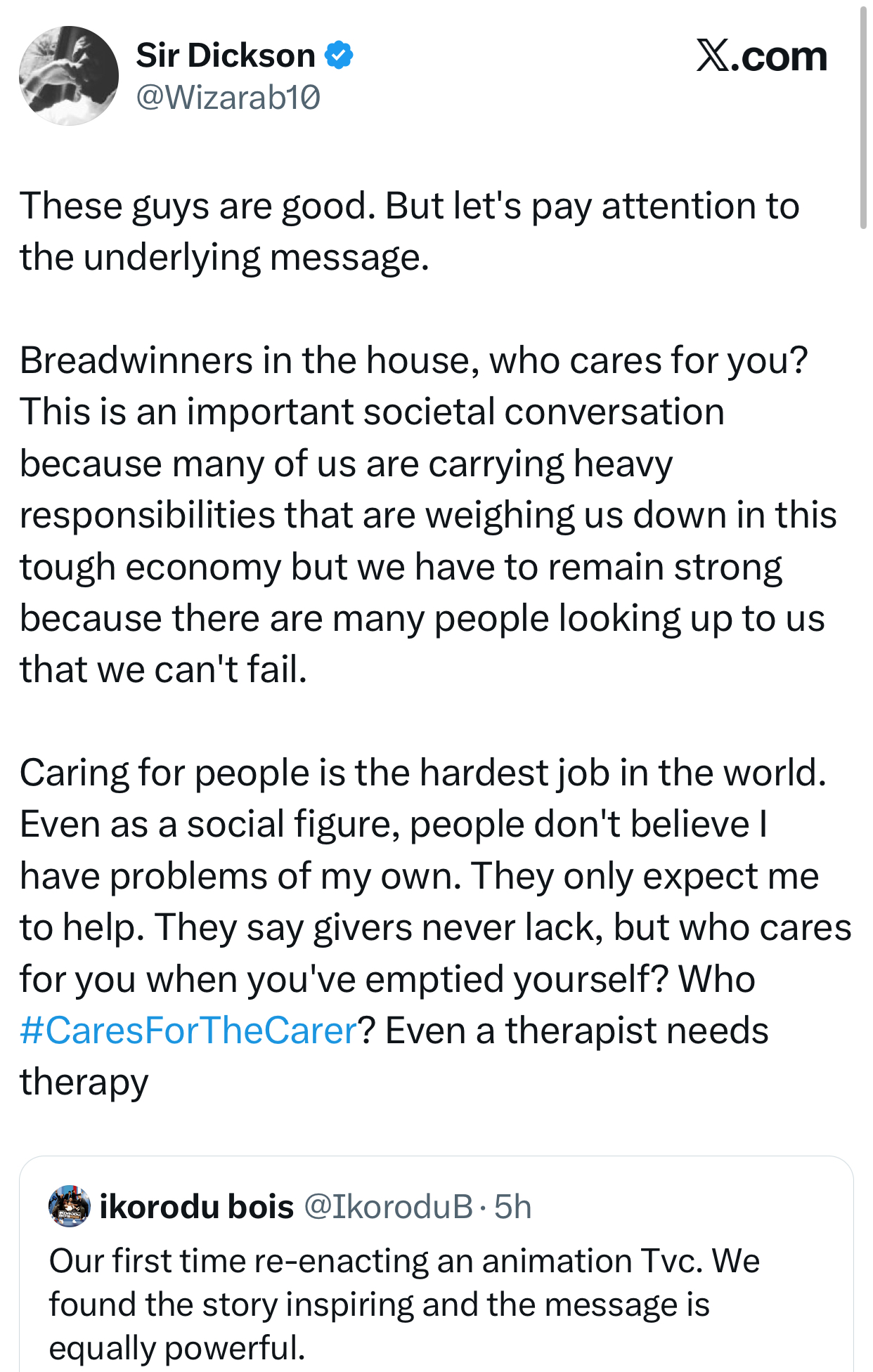

Recent conversations on X about Caring for the Carer went viral, sparking an important question: Who shows up for the person who shows up for everyone?
One thing became clear from the conversations: care is deeply woven into Nigerian society. From breadwinners shouldering the financial responsibilities of both their nuclear and extended families to firstborns looking out for their younger siblings to medical professionals and teachers whose careers are built around caring for others, much of our society rests on the shoulders of people who show up for others. But while we recognise and celebrate their sacrifices, one question remains: Who cares for the carers of our society?
An AXA Mansard film, recreated by Ikorodu Bois, brings this question to life through the emotional story of Pere, a fisherman torn between caring for his sick mother and providing for their needs. His story captures a familiar reality: the weight of caring for someone else, even when you have your own struggles. At its heart is a simple but powerful question: Who cares for the carer?

Because we all know that person. The one who always seems to have the answers. The one who picks up at 2 am. The one who says, “Don’t worry, I’ll sort it out,” before you’ve even finished explaining the problem. We love them. We admire them. We proudly tell people about them. “Ah, my sister is so strong.” “My dad is a rock.” “That friend of mine, she’s too responsible.”
But somewhere between celebrating their strength and relying on their dependability, we can forget that they, too, need someone to lean on.
Are We Too Good At Being Good?
Let’s be fair. Nigerians are a communal people, and care is deeply ingrained in our culture. A firstborn worrying about secondary and university school fees. We have people in the society who show up for us: from contributing to burial expenses and weddings to paying for hospital bills. We support relatives we’ve never even met. Community is part of who we are, and that is beautiful. It is something worth holding on to.
But perhaps there is another side to our culture of responsibility that we are not seeing and Nigerians are speaking up. In a society where showing up for others is expected and celebrated, asking for help can feel almost like a failure. The person everyone relies on may find it hardest to admit they’re struggling, too.
So Here’s Your Homework
Think about these people;
The one you always call.
The one who always sends money.
The one who always solves the problem.
The one who always says “I’m fine.”
The one who is always available for everybody except themselves.
You know exactly who came to mind.
What actionable step are you going to take to make sure they are cared for? Because the truth is, the person who is always there for you is waiting for someone to be there for them.