

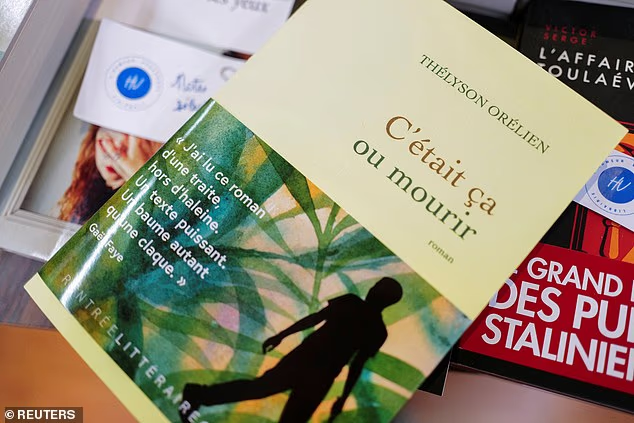

A prize-winning novel lauded as the literary sensation of the year has been accused of using artificial intelligence (AI) to write his first novel.
Award-winning Canadian-Haitian author Thélyson Orélien, 38, recently won the Prix du Roman Fnac for C’était ça ou mourir (It Was Either That or Die).

His debut novel is also on the early lists for France‘s prestigious Goncourt and Renaudot prizes.
But on Tuesday, a little-known group called Balance ton Claude (Denounce your Claude, in reference to Anthropic’s AI assistant) claimed the book was “almost totally” written by AI – a charge the author denied.
“We tested several passages, from different bits of the manuscript, to come up with the identical result: 100 percent AI,” the group said on X.
According to the group – whose membership is unclear – the detection was carried out by a programme called Pangram, which it said was “by far the most accurate”, with an almost negligible chance of making a mistake.
Orélien, who was born in Haiti and moved to Montreal in 2010, immediately denied the accusation.
“I have always loved creation and literature. I can’t see why I would feel compelled to use a machine,” he told Libération newspaper. He said he was “compiling a dossier” with his editor to prove that he authentically wrote the book.
“My traditions are Haitian and Caribbean. The images, the repetitions and the rhythms are the living word, they are my own,” he said.
The publishing house Grasset also came to his defence, saying the allegations “are atrociously injurious to a writer with an exceptional life-story” whose “work of creation is original and powerful.”
The novel tells the story of a teacher who flees gang violence in Haiti and his adventures before he finally makes it to Canada, where he re-discovers “the right to breathe without fear”.