

When asking the question of who will win a tournament, there typically exists a moment when fans have asked this question repeatedly before the start of a tournament. During this latter period, the betting markets and their predicting participants are detailed as to the probabilities of each of these leading contenders being able to win.
As can be seen by the way in which different betting communities utilize analysis. Which is shared on different platforms such as https://afropari.ng/ and research to help inform their choices rather than relying solely on instinct and emotion-based decisions, most of these individuals now focus more on looking into how well teams meet expectations regarding squad depth, tactical flexibility, and consistency of performance.
In very few instances will a team showing dominance for an entire tournament (from beginning to end) ultimately be crowned its champion. Most of the time, playoffs have a way of allowing weaker teams, that were perhaps previously viewed as favorites to win at some point, to become stronger through later stages of playoffs; hence, predicting which teams have realistic potentials to become champions is key knowledge every betting participant can have when studying previous tournaments for clues related to team performance based on historical and current trends of previous winning teams.
Why don’t the favorites always win tournaments
History shows that teams that show a balanced distribution of talent (roster) and utilize a calm and methodical style of making decisions tend to be more successful in progressing through tournaments than their counterparts with any other combinations of talent or decision-making styles.
Another important consideration for progressing through a tournament is injury. A strong team may ultimately succumb to the loss of one important player late in the tournament. As betting markets react so quickly to changes in a team’s lineup stability, injury, and/or roster changes will create volatility in a team’s form.
Teams have also been successful in tournaments based on momentum. For example, if a team is able to win a difficult game, they tend to gain confidence and perform at a higher level for the remainder of the tournament than they would have had they lost that high-pressure match. On the other hand, sometimes underdogs have used the momentum from winning a difficult match to gain a competitive advantage over their next opponent, and as a result, ultimately pull off unexpected victories.
Factors shaping tournament winner predictions
There are some common traits among teams that usually win when analyzing tournaments. Teams that repeatedly win during tournaments possess certain traits, such as:
- Great all-around defence play for every game
- A lot of excellent goal scorers who have demonstrated a high level of reliability by scoring in tense moments
- Depth to the level where they can rotate players without losing quality
- Coaches with experience in dealing with tournament pressures
- Consistent success when playing on the road
Every one of these traits helps teams when they advance through difficult knockout rounds and close games come down to very small differences.
Teams are mentally exhausted during tournaments as well. If a team plays several games requiring overtime to resolve the game, they do not have the physical stamina to continue on and compete as well later in the tournament. Bettors also monitor teams’ recovery time after games for predicting which team has the best chance of being crowned the champion.
Comparing contenders through research trends
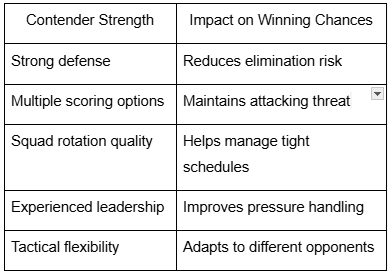
A simple comparative analysis portrays some of the characteristics that may be associated with successful tournament results.
Results show that successful teams utilize many of these characteristics to achieve success rather than relying solely on one of these tools for success.
How betting odds evolve during tournaments
Numerous studies indicate that the movement of betting odds tends to reflect public opinion (as well as actual results), so that when a popular team has success in recent competition, bettors will want to place bets on that team, and the bookmaker is forced to adjust their betting odds for that team.
Many experienced and professional bettors look for “value bets” for teams that have been able to advance through the tournament through “quiet, consistent” success.
From an odds standpoint, there is not a large period of time during which odds remain unchanged; therefore, a successful bettor should know how to adjust their betting strategy as the tournament progresses and events unfold.
Final outlook on tournament winners
When predicting the winners of a tournament-style event, it is important to be patient and adaptable because see significant changes to early predictions throughout the course of the tournament.
Likely to produce more accurate predictions by looking at statistical data, analysis of the team’s performance, and viewings of previous matches than if only relying on that team’s historical reputation.
The major takeaway for all bettors at the conclusion of a tournament is that most teams will be crowned champions based on who is playing their best when they should be.