


Former Kaduna State governor, Nasir El-Rufai, is facing multiple investigations and legal challenges involving anti-graft and security agencies, with developments emerging from the Economic and Financial Crimes Commission (EFCC), the Department of State Services (DSS), and the federal government.
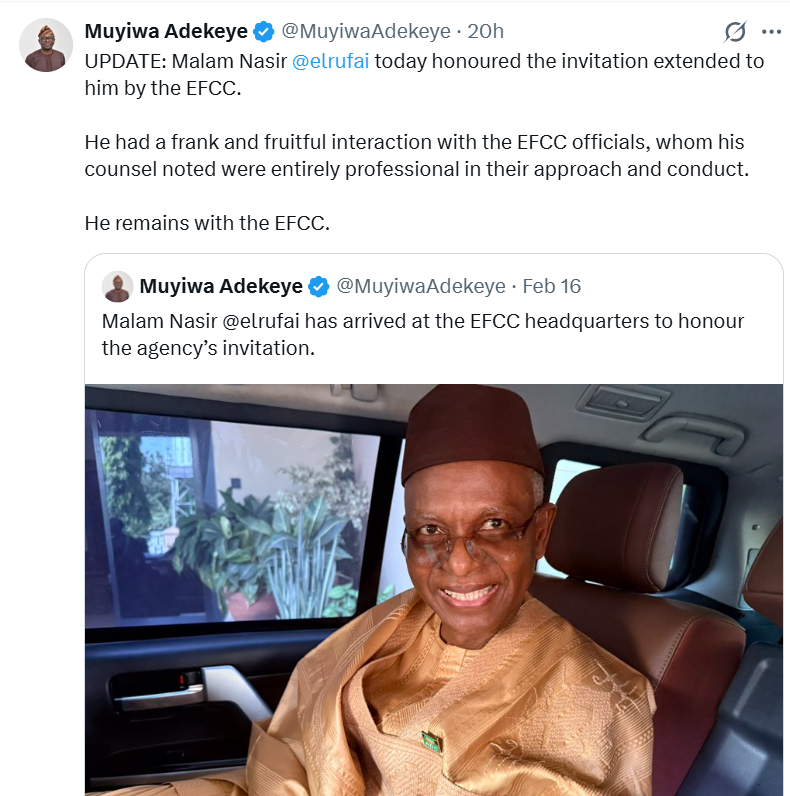
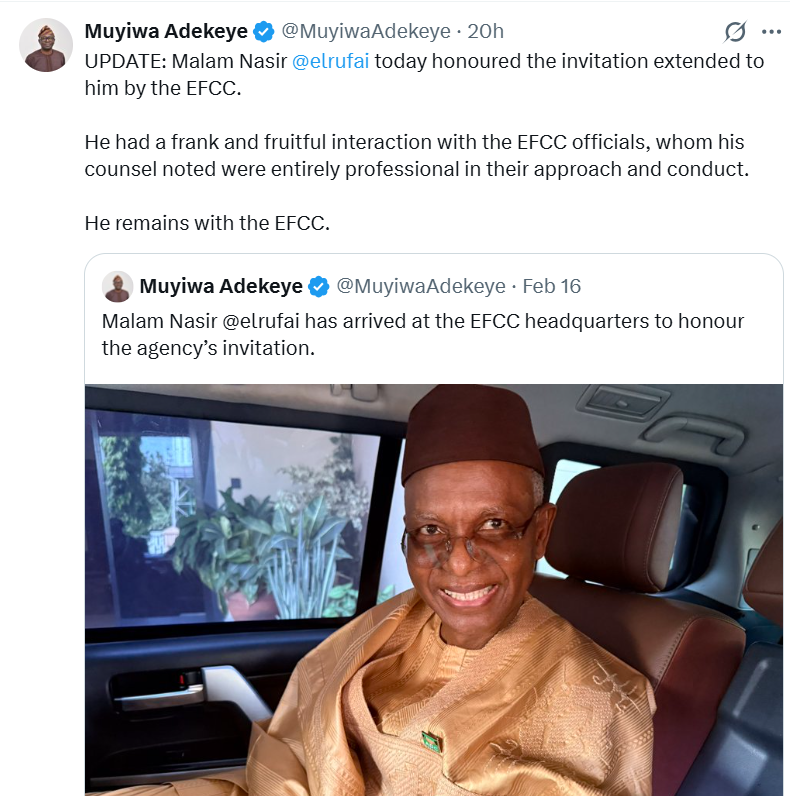
Sources at the EFCC told Daily Trust that the former governor remains with the commission in Abuja. His media aide, Muyiwa Adekeye, stated on X that El-Rufai honoured the commission’s invitation and has been cooperating with investigators.
In the post, Adekeye wrote: “UPDATE: Malam Nasir @elrufai today honored the invitation extended to him by the EFCC. He had a frank and fruitful interaction with the EFCC officials, whom his counsel noted were entirely professional in their approach and conduct. He remains with the EFCC.”
EFCC sources indicated that two investigations are ongoing, one relating to alleged terrorism financing and the other concerning alleged financial impropriety during his tenure as governor of Kaduna State.
“There are two investigations currently ongoing in the agency. One is alleged terrorism financing. The other one bothers on alleged financial impropriety in Kaduna State when he was the governor,” a source said.
Protesters gathered outside the EFCC headquarters in Abuja ahead of El-Rufai’s arrival, with some demonstrating in support of him while others urged the commission to thoroughly question him. There was a brief scuffle when some individuals who accompanied him were prevented from entering the premises.
In addition to the EFCC probe, the federal government, through the DSS, filed a three-count charge against the former governor. The Kaduna State House of Assembly had earlier indicted El-Rufai and several aides over the alleged siphoning of more than N4 billion in state funds during his administration between 2015 and 2023. The ad hoc committee that investigated the matter alleged that some loans obtained during his tenure were not used for their intended purposes and that due process was not followed in certain cases.
The House recommended that Governor Uba Sani refer El-Rufai and other former officials to security and anti-corruption agencies for investigation and possible prosecution.
Meanwhile, DSS operatives confirmed the seizure of El-Rufai’s passport as part of efforts to reopen investigations into the 2019 disappearance of Abubakar Idris, also known as Dadiyata. Idris was abducted from his Kaduna home in 2019 after publicly criticising the El-Rufai administration. Speaking on ARISE Television, El-Rufai had referenced a confession allegedly made by a police officer regarding the abduction.
“Three years after he was abducted, a policeman who was posted from Kano to Ekiti State confessed to someone that they were sent from Kano to abduct Dadiyata and that the officer was worried about that. That is all I know,” El-Rufai had stated. He added: “If anybody is to be asked about the disappearance of Dadiyata, it is the Kano State government; it has nothing to do with the Kaduna State government. We didn’t even know he existed.”
A DSS official told the publication that the passport was seized to prevent him from leaving the country, noting that the investigation would be broadened.
The former governor is also being probed over alleged wiretapping of the National Security Adviser, Nuhu Ribadu. The federal government filed charges under the Cybercrimes (Prohibition, Prevention, etc.) Amendment Act, 2024 and the Nigerian Communications Act 2003, alleging unlawful interception of communications and compromise of public safety.
The charges cite statements allegedly made by El-Rufai during an interview on ARISE TV in which he admitted to listening to intercepted communications.