


A Nigerian pharmacist who practices in the United States of America has responded to a Catholic priest who condemned several forms of family planning.
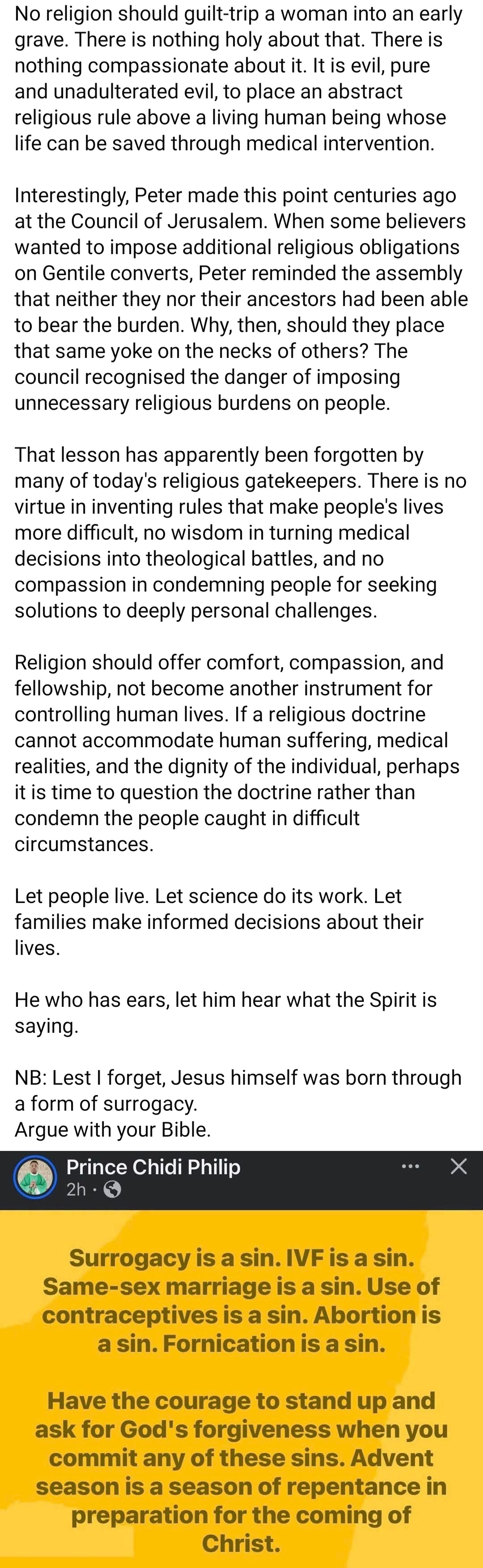
Reverend Father Chidi Philip took to Facebook to list the acts the church considers to be sins and he included IVF, surrogacy, and contraceptives.
The post from the priest has sparked a debate.
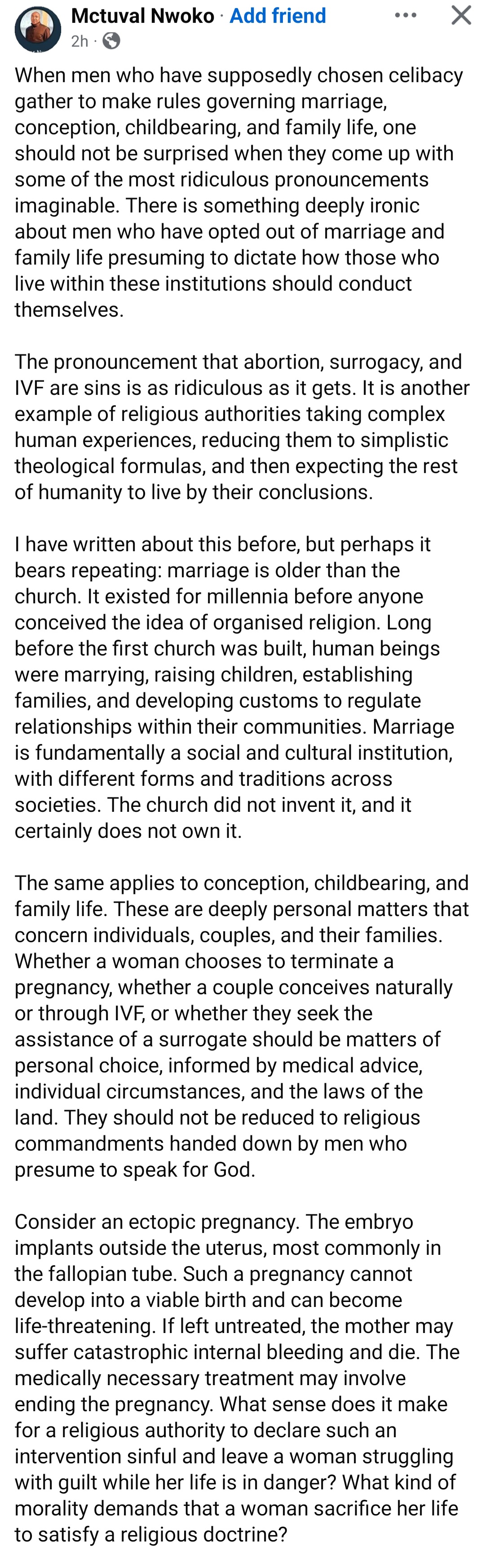
Weighing in, Mctuval Nwoko, a Nigerian pharmacist who lives in the US, questioned why a priest who chose celibacy would make rules for married people.
Nwoko wrote: “When men who have supposedly chosen celibacy gather to make rules governing marriage, conception, childbearing, and family life, one should not be surprised when they come up with some of the most ridiculous pronouncements imaginable. There is something deeply ironic about men who have opted out of marriage and family life presuming to dictate how those who live within these institutions should conduct themselves.
“The pronouncement that abortion, surrogacy, and IVF are sins is as ridiculous as it gets. It is another example of religious authorities taking complex human experiences, reducing them to simplistic theological formulas, and then expecting the rest of humanity to live by their conclusions.
“I have written about this before, but perhaps it bears repeating: marriage is older than the church. It existed for millennia before anyone conceived the idea of organised religion. Long before the first church was built, human beings were marrying, raising children, establishing families, and developing customs to regulate relationships within their communities. Marriage is fundamentally a social and cultural institution, with different forms and traditions across societies. The church did not invent it, and it certainly does not own it.
“The same applies to conception, childbearing, and family life. These are deeply personal matters that concern individuals, couples, and their families. Whether a woman chooses to terminate a pregnancy, whether a couple conceives naturally or through IVF, or whether they seek the assistance of a surrogate should be matters of personal choice, informed by medical advice, individual circumstances, and the laws of the land. They should not be reduced to religious commandments handed down by men who presume to speak for God.
“Consider an ectopic pregnancy. The embryo implants outside the uterus, most commonly in the fallopian tube. Such a pregnancy cannot develop into a viable birth and can become life-threatening. If left untreated, the mother may suffer catastrophic internal bleeding and die. The medically necessary treatment may involve ending the pregnancy. What sense does it make for a religious authority to declare such an intervention sinful and leave a woman struggling with guilt while her life is in danger? What kind of morality demands that a woman sacrifice her life to satisfy a religious doctrine?
“No religion should guilt-trip a woman into an early grave. There is nothing holy about that. There is nothing compassionate about it. It is evil, pure and unadulterated evil, to place an abstract religious rule above a living human being whose life can be saved through medical intervention.
“Interestingly, Peter made this point centuries ago at the Council of Jerusalem. When some believers wanted to impose additional religious obligations on Gentile converts, Peter reminded the assembly that neither they nor their ancestors had been able to bear the burden. Why, then, should they place that same yoke on the necks of others? The council recognised the danger of imposing unnecessary religious burdens on people.
“That lesson has apparently been forgotten by many of today’s religious gatekeepers. There is no virtue in inventing rules that make people’s lives more difficult, no wisdom in turning medical decisions into theological battles, and no compassion in condemning people for seeking solutions to deeply personal challenges.
“Religion should offer comfort, compassion, and fellowship, not become another instrument for controlling human lives. If a religious doctrine cannot accommodate human suffering, medical realities, and the dignity of the individual, perhaps it is time to question the doctrine rather than condemn the people caught in difficult circumstances.
“Let people live. Let science do its work. Let families make informed decisions about their lives.
“He who has ears, let him hear what the Spirit is saying.
“NB: Lest I forget, Jesus himself was born through a form of surrogacy. Argue with your Bible.”