

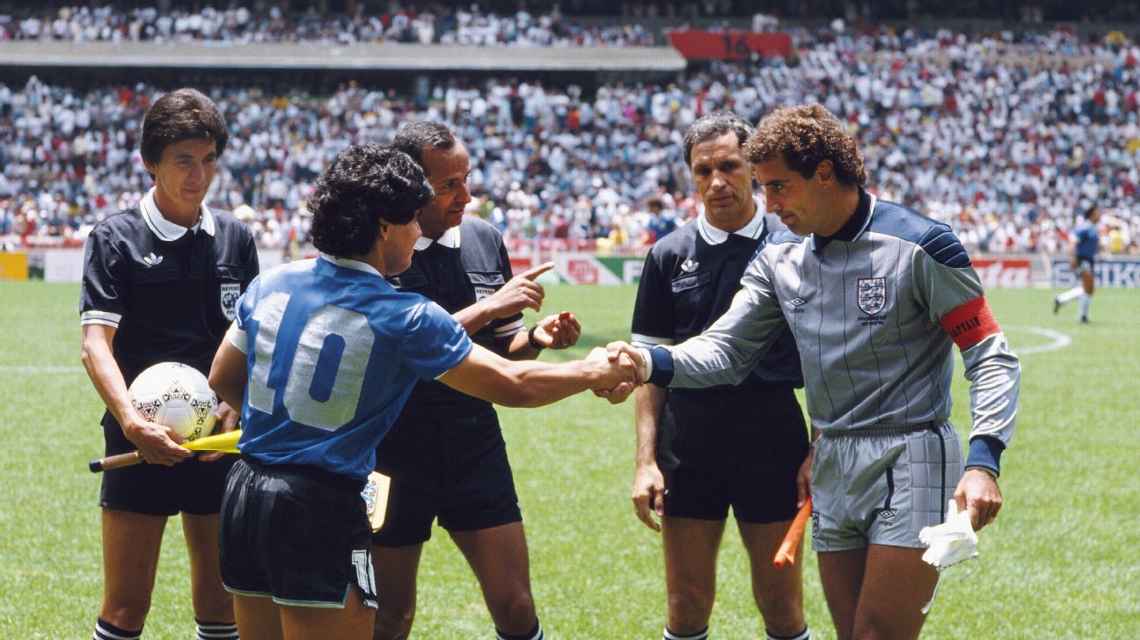
Some football matches are simply games. England versus Argentina has never been one of them.
When the two nations walk onto the pitch for their 2026 FIFA World Cup semifinal in Atlanta, they will not just be playing for a place in the final.
They will be adding another unforgettable chapter to a rivalry that has defined generations, divided continents, produced football’s greatest heroes and villains, and repeatedly changed the history of the World Cup itself.
For more than six decades, England and Argentina have collided on football’s biggest stage in matches filled with controversy, revenge, heartbreak, political tension and moments that continue to shape the sport.
From Diego Maradona’s infamous “Hand of God” to David Beckham’s redemption arc, from police escorting a captain off the pitch to Lionel Messi finally preparing for his first-ever international meeting with England, this is not just another semifinal.
It is football’s greatest unfinished story.
A Rivalry Born Before Most Fans Were Alive
England and Argentina first crossed paths at a World Cup in Chile in 1962, when England secured a comfortable 3-1 victory in the group stage.
Few could have imagined that the fixture would eventually become one of football’s fiercest rivalries.
Everything changed four years later.
1966: The Match That Changed Football Forever
England were hosting the World Cup and faced Argentina in a fiery quarterfinal at Wembley.
The game finished 1-0 thanks to Geoff Hurst’s winner.
Yet almost nobody remembers the goal. Instead, history remembers Antonio Rattín.
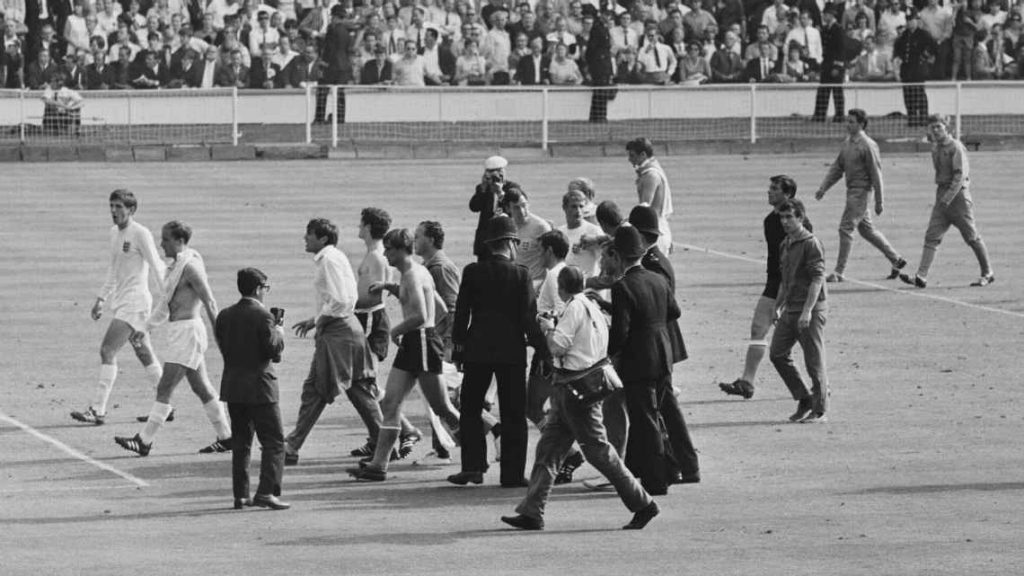
Argentina’s captain was sent off by German referee, Rudolf Kreitlein for dissent.
The problem?
Rattín insisted he had no idea why.
Unable to understand the referee’s instructions because of the language barrier, he repeatedly demanded an interpreter.
For almost 10 minutes he refused to leave the field. Eventually, police officers escorted him off the pitch.
As he departed, Rattín sat defiantly on the royal carpet reserved for Queen Elizabeth II, creating one of football’s most unforgettable images.
The incident proved so embarrassing for FIFA that it directly led to one of football’s biggest innovations, the introduction of yellow and red cards.
England manager, Alf Ramsey further inflamed tensions after refusing to allow his players swap shirts with Argentina.
He famously described the Argentines as “animals.”
Rattín never accepted the decision.
“I saw that this German gentleman [referee] was calling everything in England’s favor,” he later said.
“Well, not ‘gentleman.’ I take it back.”
“This bad guy was giving them everything: corners, fouls. He was even inventing handballs.”
“Everything for the home team.”
“So I showed him my captain’s armband and for several minutes I asked him for an interpreter to explain.”
“I kept insisting the referee bring in an interpreter, and he sent me off.”
“That World Cup was rigged for the English to win. And in the final against West Germany, they were awarded a phantom goal.”
Ironically, Rattín passed away just days before Argentina’s 2026 quarterfinal victory over Switzerland.
The Albiceleste honoured him by wearing black armbands.
Politics Enter the Picture
The rivalry took on an even deeper meaning after the 1982 Falklands/Malvinas conflict between Britain and Argentina.
Football suddenly became far more than football.
Every meeting thereafter carried emotional and political weight, especially for Argentina.
Former defender, Oscar Ruggeri recalled Diego Maradona’s emotional team talk before facing England in 1986.
“‘Come on, lads, they killed a bunch of our kids.’”
Ruggeri admitted the conflict was impossible to ignore.
“We went out there with a huge energy. Even though we saw it as just a football match, you couldn’t get that out of your head.”
“We couldn’t see the people in Argentina the way footballers can today.”
“They were sending us videos from Argentina where the people were saying, ‘We don’t care what happens next — just win this match.’”
1986 “Hand of God“: The Day Football Changed Forever
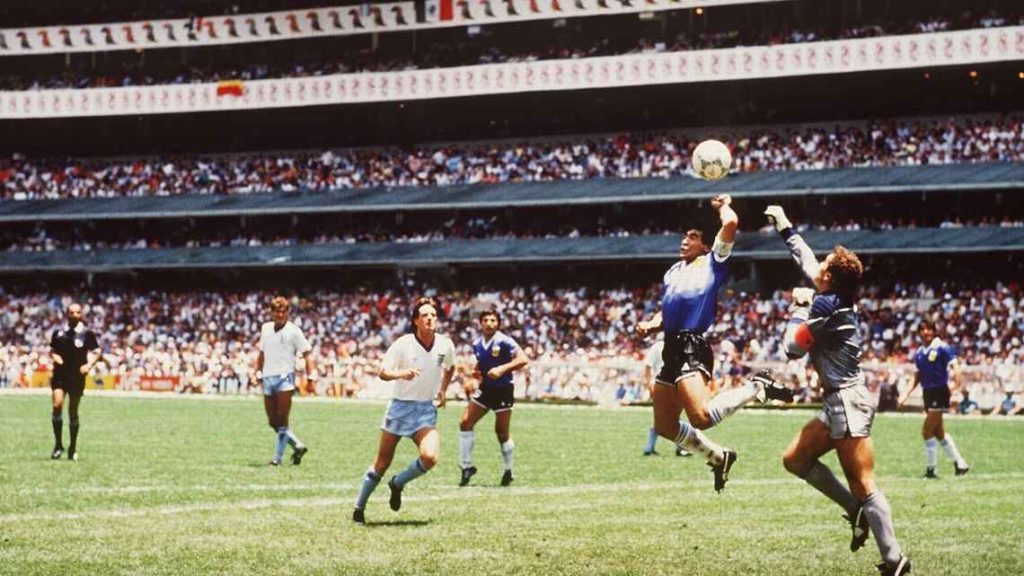
If football has one defining image… It is Diego Maradona leaping above Peter Shilton inside Mexico City’s Azteca Stadium.
The ball never touched his head. It struck his hand.
England protested furiously.
The referee allowed the goal.
Four minutes later, Maradona dribbled through virtually the entire England team to score what many still call the greatest World Cup goal ever.
Two goals.
One football match.
One player.
Two completely opposite reasons for immortality.
Afterwards Maradona delivered perhaps football’s most famous quote.
“A little with the head of Maradona and a little with the hand of God.”
To England, it was cheating. To Argentina, it was revenge.
Years later Maradona admitted:
“I knew it was my hand.”
“It wasn’t my plan, but the action happened so fast that the linesman didn’t see me putting my hand in.
“The referee looked at me and he said: ‘Goal.’
“It was a nice feeling, like some sort of symbolic revenge against the English.”
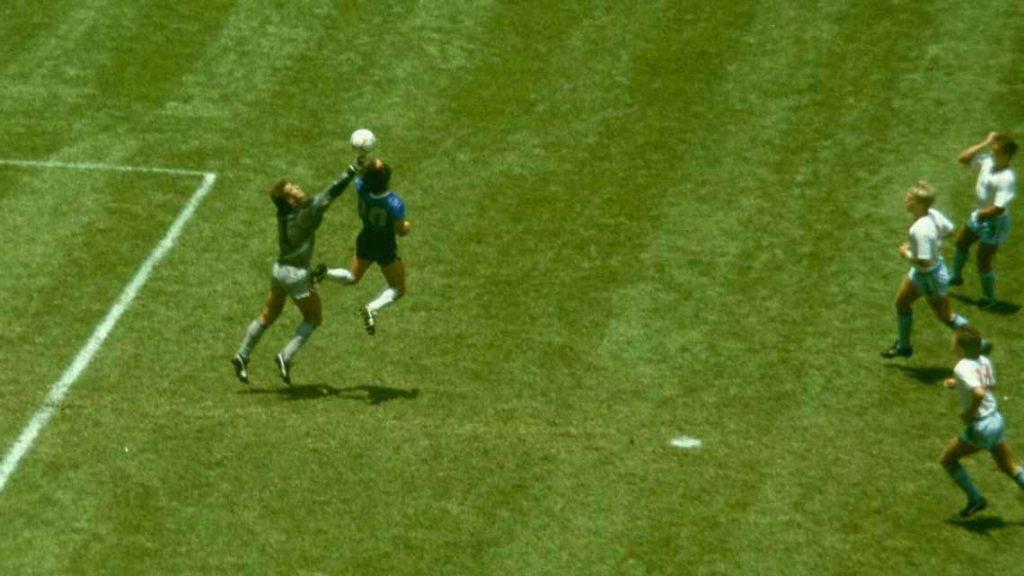
England goalkeeper, Peter Shilton never forgave him.
“What I don’t like is that he never apologized.”
“Never at any stage did he say he had cheated and that he would like to say sorry.”
“Instead, he used his ‘hand of God’ line. That wasn’t right.”
“He challenged me for a high, looping ball, but knew he wouldn’t get it with his head, so he punched it into the net.”
“A clear offense. Cheating.”
Former England defender Terry Butcher was equally blunt.
“I’ll never forgive him [Maradona].”
“At the end of the day, it’s not nice when you lose a World Cup quarterfinal under those circumstances.”
“It’s very hard to forgive and forget.”
Argentina lifted the World Cup one week later.
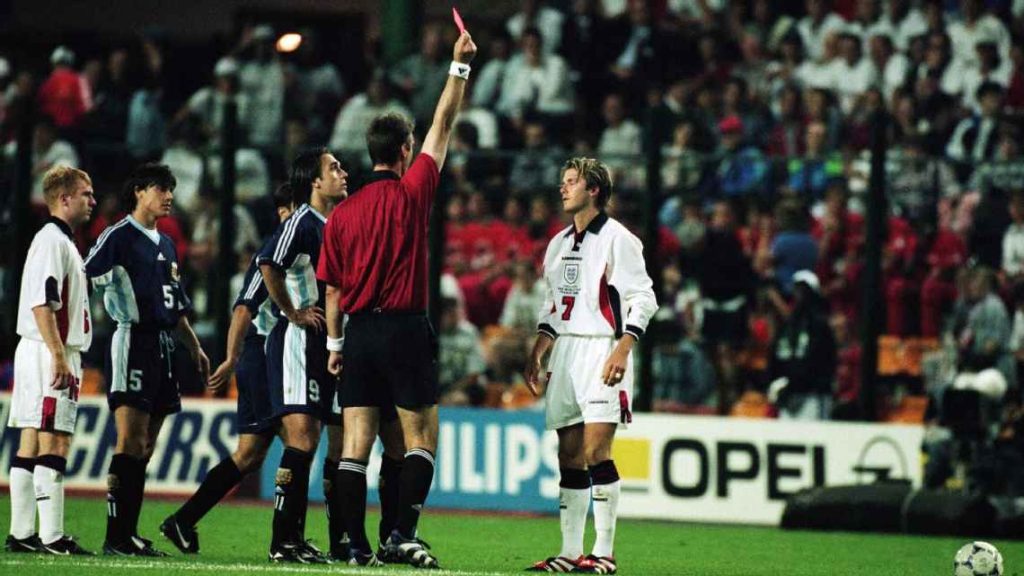
1998: Beckham Becomes England’s Villain
Twelve years later, another England star found himself at the centre of controversy.
David Beckham.
The match finished 2-2 after goals from
- Alan Shearer,
- Michael Owen,
- Gabriel Batistuta and
- Javier Zanetti.
Then Beckham reacted to a foul from Diego Simeone.
A kick. A red card.
England played almost an hour with ten men before losing on penalties.
Back home Beckham became public enemy number one.
He later reflected:
“I remember Diego putting his hand on the back of my head, either rubbing it or pulling my hair a little bit, and then I just reacted.”
“With the sending-off, what led after it for the next few years, I think for me personally, that was the most difficult time for me in my career.”
Simeone later admitted he exaggerated the incident.
“I had tackled him, and we both fell to the ground.”
“As I was trying to stand up that was when he kicked me from behind and I took advantage of that.”
“And I think any person would have taken advantage of that in just the same way.”
Simeone also agreed the rivalry always felt different.
“Quite apart from all the political history, the desire of the whole country is to defeat England.”
“Every time we meet, this desire to win is bigger and more heartfelt.”
“This is a classic.”
Paul Scholes remembered another lasting image.
“What sticks in my mind from that game, and what really pissed me off, was the way the Argentina players celebrated afterward.”
“They were on the team bus, with their tops off, swinging their shirts, singing their songs and goading us.”
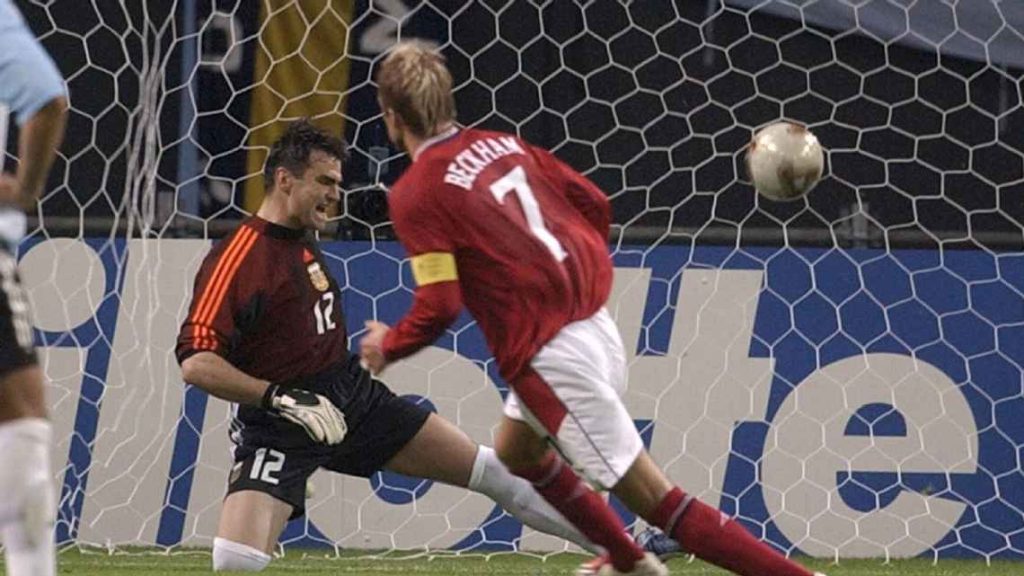
2002: Beckham Finally Gets Revenge
Four years later, Beckham returned with unfinished business.
England won 1-0 after Michael Owen won a controversial penalty against Mauricio Pochettino.
Beckham calmly converted.
Redemption.
Years of criticism disappeared in one kick.
He later admitted:
“I knew that was my moment to step up.”
“The moment we got the penalty, I knew I was taking it.”
“With my celebrations after scoring, I think everyone saw how much it meant to me.”
“It was one of those moments where the England fans and the public maybe forgave me.”
Pochettino never accepted the decision.
In 2016 he joked:
“It was 15 years ago when Owen dived.”
“Don’t believe that English football is always fair because Owen jumped like [he was] in a swimming pool.”
“Come on! I didn’t touch him. I promise you. It’s true.”
Later he admitted:
“It was a penalty because it was given.”
“From the referee’s angle, I probably would have given it, but I never touched Owen.”
He even convinced Owen to sign a famous photograph.
“He signed it and wrote, ‘You definitely touched me’ along with a smiley face.”
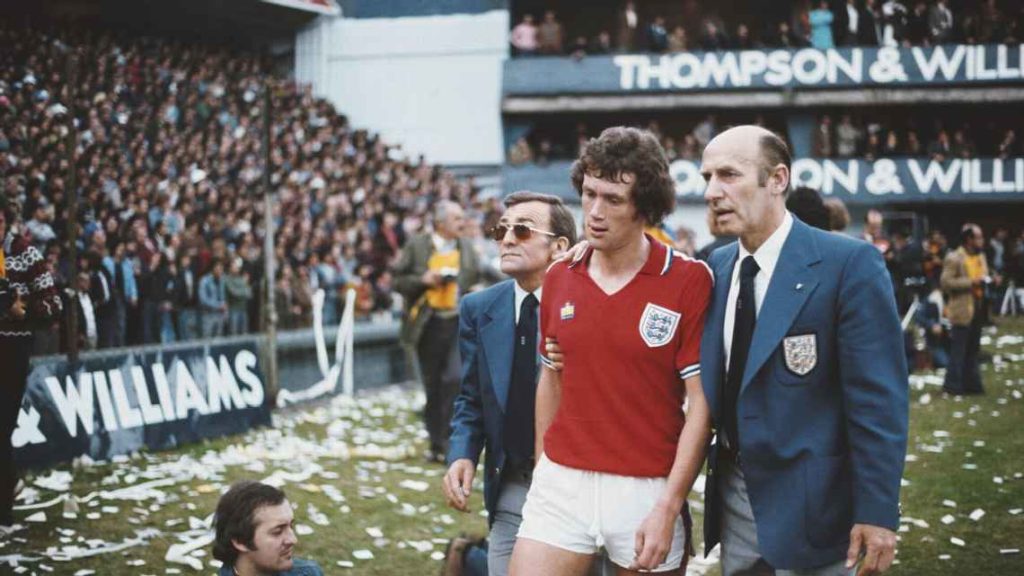
The Forgotten Punch
One of the rivalry’s lesser-known moments came in a 1977 friendly at La Bombonera.
Trevor Cherry flew into a reckless tackle on Daniel Bertoni.
Bertoni responded by punching Cherry in the mouth.
The England defender lost his two front teeth.
Both players were sent off.
Cherry became the first England player ever dismissed in an international friendly.
Now Comes a New Chapter
Twenty-four years after Beckham’s redemption.
Forty years after Maradona’s masterpiece.
Sixty years after Rattín changed football forever.
England and Argentina meet again, but this time the story belongs to Lionel Messi.
Remarkably, despite playing six World Cups and facing almost every major football nation, the eight-time Ballon d’Or winner has never faced England in an international match.
Following Argentina’s quarterfinal victory over Switzerland, Messi admitted the occasion would be unique.
“Everything I have seen and remember [about Argentina vs. England from 1986] is from videos and images that Argentinians constantly watch and relive.”
“But I think this group is used to playing football matches regardless of the opponent.”
“Obviously, playing against England is special because they are a powerhouse, and matches against powerhouses are always special.”
“Personally, it’s the first time I’m going to play against them.”
“I’ve played against everyone except England, so it will be nice for that reason too.”
“And we’ll experience it for what it is: a World Cup semifinal against a powerhouse, a great team, and we’ll try to arrive in the best possible shape to compete again.”
– Read More: Lionel Messi Fires Warning to England Ahead World Cup Semi-final Clash
More Than a Match
This semifinal is not simply England versus Argentina. It is;
- Rattín versus Ramsey.
- Maradona versus Shilton.
- Beckham versus Simeone.
- Politics versus sport.
- Justice versus controversy.
- Memory versus revenge.
And now, for the first time, Lionel Messi will write his own chapter in football’s most dramatic international rivalry.
Whatever happens in Atlanta, history guarantees one thing.
England versus Argentina never ends with just a final whistle.
(Credit: ESPN)