

The United States Supreme Court has struck down sweeping global tariffs imposed by President Donald Trump.
In a 6–3 decision delivered on Friday, the court affirmed a lower court’s finding that Trump’s reliance on the 1977 International Emergency Economic Powers Act (IEEPA) to introduce the tariffs was unlawful.
It was a rare setback for the administration, from a Supreme Court with a 6-3 conservative majority that has regularly backed Trump on various contentious cases since he took office.
The ruling was written by Chief Justice John Roberts, who was joined by two of his fellow conservatives, Justices Neil Gorsuch and Amy Coney Barrett, and the three liberal justices. Conservative Justices Samuel Alito, Clarence Thomas and Brett Kavanaugh dissented.
“The Framers did not vest any part of the taxing power in the Executive Branch,” Roberts wrote.
The majority did not address whether companies could get refunded for the billions they have collectively paid in tariffs.
In Georgia on Thursday, ahead of the ruling, Trump called his policy “common sense.”
“Without tariffs, this country would be in so much trouble right now,” he said.
“We’re taking in hundreds of billions of dollars,” he said. “We’re going to be taking in next year $900 billion in tariffs, unless the Supreme Court said, ‘You can’t do it.’ Can you believe it? That I have to be up here, trying to justify that?”
During oral arguments in November, the tariffs dispute seemed to be going against Trump, with the justices indicating Trump might not have the authority to impose tariffs under a law designed for use during a national emergency.
The legal question was whether a 1977 law called the International Emergency Economic Powers Act, or IEEPA, which allows the president to regulate imports when there is a national emergency, extends the power to impose global tariffs of unspecified duration and breadth.
The Constitution states that the power to set tariffs is assigned to Congress. The 1977 law, which does not specifically mention tariffs, says the president can “regulate” imports and exports when he deems there to be an emergency, which occurs when there is an “unusual and extraordinary threat” to the nation.
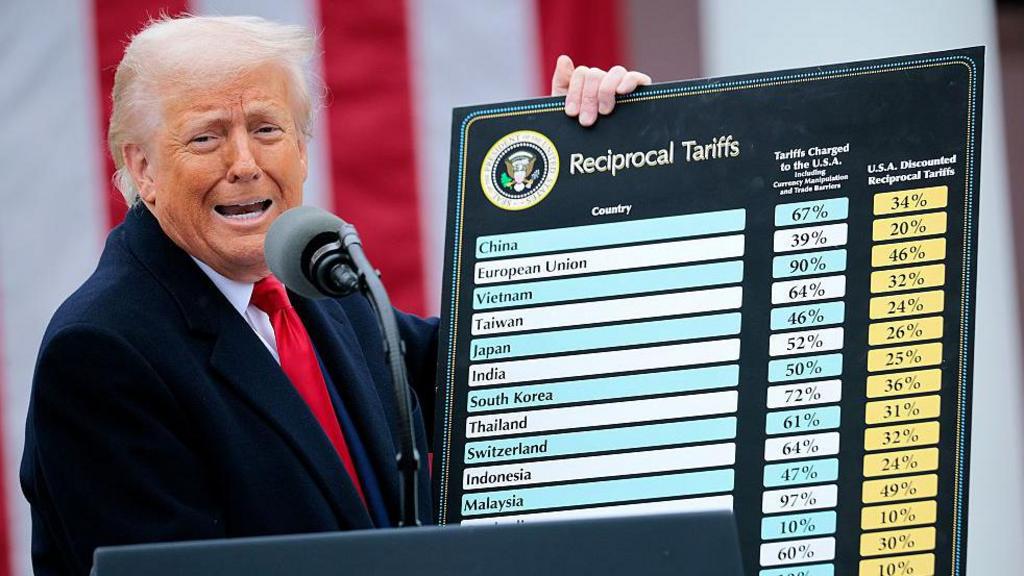
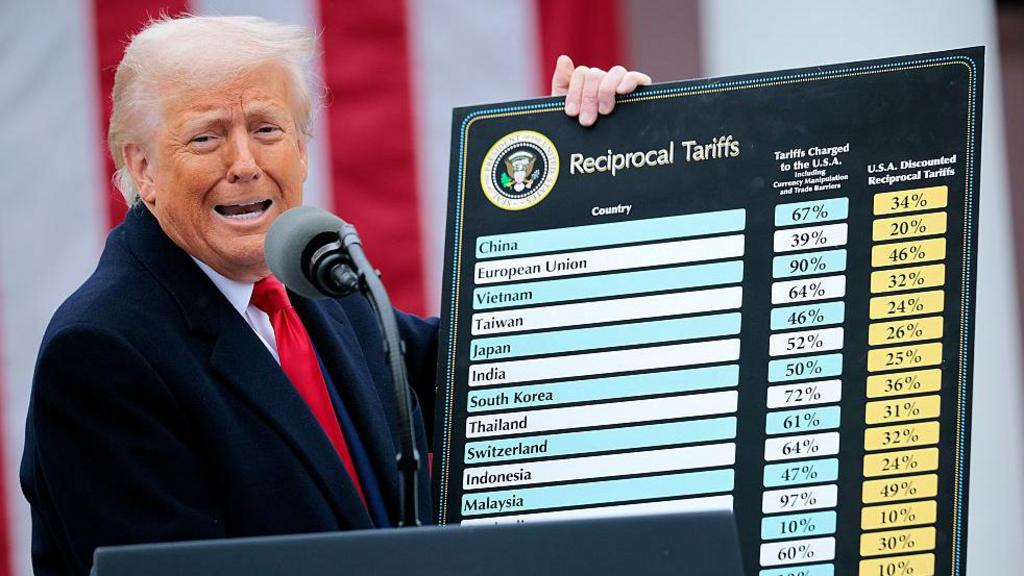
Trump invoked the law to impose so-called “reciprocal” tariffs on goods imported from nearly every foreign trading partner to address what he called a national emergency related to U.S. trade deficits.
“The tariffs at issue here may or may not be wise policy,” Kavanaugh wrote in the dissent. “But as a matter of text, history, and precedent, they are clearly lawful.”
The decision does not affect all of Trump’s tariffs, leaving in place ones he imposed on steel and aluminum using different laws, for example, NBC News noted. But it affects his country-by-country or “reciprocal” tariffs, which range from 34% for China to a 10% baseline for the rest of the world, and a 25% tariff imposed on some goods from Canada, China and Mexico for what the administration said was their failure to curb the flow of fentanyl.
Trump could seek to reimpose the tariffs, using other laws, as NBC News reported.
The economic impact of Trump’s tariffs has been estimated at some $3 trillion over the next decade, according to the Congressional Budget Office, The Associated Press reported. The Treasury has collected more than $133 billion from the import taxes the president has imposed under the emergency powers law, federal data from December shows. Many companies, including the big-box warehouse chain Costco, have already lined up in court to demand refunds.